Showing posts with label book reviews. Show all posts

Monday, October 13, 2008

The Shack -- Initial Impressions


I had heard of The Shack a few months ago, but did not feel impelled to go out and buy it. A week ago a friend recommended it and I put it on my mental "to do" list. Friday I was at Barnes and Noble doing my regular browse-the-shelves thing, and I found myself walking past the religion books and saw the book. I pulled it from the shelf and added it to Susan's choice and began reading it at around 7:30pm Saturday evening. About 1:30am Sunday morning I read the last few lines, closed the book, and went to sleep.

The Shack proved to be a moving story and one I could not easily put off, once I reached a certain point. If you are looking for traditional theology explaining how a just God can allow evil, then this book will disappoint. If you are willing to let yourself view God in some non-traditional ways then give it a try.

In many ways, this is the Book of Job written for the 21st century. I saw a smattering of C.S. Lewis scattered here and there, but mostly this was an account of what might happen if a grief-paralyzed man had an opportunity to question God. There are twists and turns even up to the last page, but it was, for me, a moving account of how God might interact with even me.

One piece of theology expressed in this book (paraphrased) is in the protagonist's asking if all roads led to God. The answer was no, most roads lead nowhere -- but there are no roads that God would not take to reach those whom he loves. And that casts far wider a net than most of us can imagine.

Thursday, July 26, 2007

Book Review: Harry Potter and the Deathly Hallows

Well, it was a wild ride, and I had to go back and review at several points, but I got through Harry Potter and the Deathly Hallows with far more understanding of what was going on in the previous books. Rowling has outdone herself, and skillfully tied it all together for the readers.

This book was full of death, and many familiar characters died, but the outcome, overall, was satisfying.

In a way this series mirrors life in the muggle world -- in times of conflict people will die and people will live. In our own Civil War families lost fathers and sons, and sometimes they died serving in opposing armies. Today, Christians in the Sudan and Middle East are persecuted for their faith, and there is no guarantee that the good will survive and the evil will die. Yesterday, one of the 23 Korean Christian aid workers taken hostage in Afghanistan was murdered and his body left on the road. There is no sense in any of this, but our hope is in the presence of God through it all.

In the Harry Potter series, it was Love that sustained the characters; something Voldemort could neither understand nor counter.

The previous two posts on this blog were on two thoughtful reviews of Harry Potter and the Deathly Hallows, and neither gave the book unqualified praise (or condemnation). On can find strong condemnation in other reviews, but as one who has read C.S. Lewis and J.R.R. Tolkien, I have to say that fantasy literature is not the real world; it may reflect the real world, but as with Paul's mirror, it is a dim a reflection. And eventually we all have to stop looking in the mirror and see things "face to face".

While the Chronicles of Narnia are more overtly Christian, there are large differences between Scripture and how things transpired in Narnia. But that is the point, isn't it? Lewis said that in his world where the animals talked, the Saviour would necessarily be one of them -- a Talking Beast.

As for Tolkien, well, I just have to say that finding Christian themes in Harry Potter is about as easy as finding Christian themes in The Lord of the Rings. It's there if you look for it, but there is very little that is explicit.

I'm not saying that J.K. Rowling will take a place on the same level as Tolkien or Lewis, but it has become obvious over the past several years that she didn't just slap all this together. In fact, there are indications that she will take her notes on characters, places, and events and compile them into an encyclopedia. I look forward to seeing this.

Will J.K. Rowling be able to really sit back and enjoy life without deadlines? Hard to say. It's not as if she has slammed the door shut on sequels, but she has earned a rest. Maybe after the final movie adaptation comes out...

What Would Jonathan Edwards Say About Harry Potter? | Christianity Today

What Would Jonathan Edwards Say About Harry Potter? | Christianity Today:
"So there we have it. The most engrossing imaginative world created at the start of the 21st century is essentially pagan. Don't get me wrong—I like the Harry Potter series. I've read all of the books. And I'm sure Jonathan Edwards would have done so, too.

Edwards was acutely aware of the cultural movements of his time. He said in 'Some Thoughts Concerning the Revival' that he made it his practice to take light from wherever it came. ..."
This is the second of two Harry Potter reviews -- one that sees the Harry Potter books as pagan at their core, but with elements of truth that can be gleaned through critical reading. Both these reviews are well worth the time to read them.

I especially appreciate the comment that Josh Moody makes here about how Jonathan Edwards engaged the Enlightenment by recognizing that truth could be found and that what was not true could be engaged with Christian principles.

As I mentioned in the previous posting on Bob Smietana's review, there are "spoilers" in both reviews. I will go ahead now and make a few comments of my own in the next posting.

The Gospel According to J.K. Rowling | Christianity Today

The Gospel According to J.K. Rowling | Christianity Today:
"I first met Harry Potter when my grandmother was dying.

On New Years Day 1999, she had a massive stroke from which she would never recover. Not wanting her to die alone, we took turns sitting by her bedside, round the clock. The night I spent with her, I brought along my Bible, the biggest cup of Dunkin Donuts coffee I could find, and a new novel, picked up from the bookstore on the way to the hospital: Harry Potter and the Sorcerer's Stone.

Both the Bible and the 'Boy Who Lived' proved good company during the watches of the night. Both pointed the way to hope in the face of death."
The is the first of two excellent reviews of the new Harry Potter book (as well as the six previous volumes). Neither review is goes to the extremes, and some ways I think the two authors are actually arguing the same points. Note that both reviews contain what might be considered "spoilers".

In this review Bob Smietana sees a number of echoes of Christianity in the imagery and specific references. The one that completely blew by me from The Prisoner of Azkaban forward was the fact that Sirius Black was Harry's godfather -- Harry was baptized -- which J.K. Rowling acknowledges as being part of the background. (Apparently there is quite a body of notes that may find their way into print as an encyclopedia of Harry Potter and Hogwarts).

Other Christian references are a little more difficult to pick out, but once you see them, you nod your head in agreement.

Read the second review, and then I will do a quick review of my own.

Friday, April 20, 2007

Book Review: Religious Literacy - What Every American Needs to Know - and Doesn't by Stephen Prothero @ Blogcritics.org

Book Review: Religious Literacy - What Every American Needs to Know - and Doesn't by Stephen Prothero @ Blogcritics.org:
"What would be a theological argument for God’s sense of humor? I think it is threefold. First, God gave imperfect Man free will (this is Arminian and not Calvinist thought). That alone should be evidence enough. Second, God entrusted his Word to imperfect Man with free will to be written down and declared by that imperfect Man with free will to be God’s inerrant Word (for Fundamentalists) and divinely inspired (for Evangelicals). Third, when the imperfect Man with free will reaches the age of 40 years, he or she can be both nearsighted and farsighted at the same time. Ain’t that a kick in the head?"
I'm not sure what this paragraph I quoted from C. Michael Bailey's review of Prothero's book has to do with the topic of religious literacy, but after I thought about it a while, it seemed somehow appropriate -- especially since I am somewhat over 40 myself, and have had to correct for astigmatism since I was in my early 20s. (to oversimplify, I am nearsighted in the vertical and farsighted in the horizontal, not to mention having presbyopia since about age 35)

First, a disclaimer -- I have not yet read Religious Literacy - What Every American Needs To Know, but it is high on my list -- in fact, it will probably arrive while I am out of town next week.

So, if you read Bailey's comments on God's sense of humor and decided to click the link to his full review, you might see what prompted me to place my order for this book with Amazon.

Wednesday, October 18, 2006

Short Review: The Civil War as as Theological Crisis

The Civil War as a Theological Crisis
Mark A. Noll
Chapel Hill: The University of North Carolina Press
2006
ISBN: 0-8078-3012-7


The first impression I had of this book was its cover-- at once a compelling image and a perplexing image. The inside back cover identifies it as the Lutheran church on Main Street, Sharpsburg, Maryland. The date is September 1862. On September 17, 1862 the Battle of Antietam was fought there on a single day with 45,000 Confederate troops of the Army of Northern Virginia under Robert E. Lee and 87,000 Federal soldiers of the Army of the Potomac commanded by George McClellan. When the day was over, there were nearly 23,000 casualties split nearly evenly between North and South -- the bloodiest single day in the history of American wars. This may have been a "draw" in military terms, but Lee and his army were permitted to retreat unchallenged back across the Potomac River. Many historians believe the war could have ended right there had McClellan pressed his advantage and forced the surrender of the Army of Northern Virginia.

But I digress...

My first thought when I saw the cover with its mirrored image of the church was Lincoln's speech on accepting the nomination for US Senator from Illinois in 1858:
"...A house divided against itself cannot stand." I believe this government cannot endure, permanently half slave and half free. I do not expect the Union to be dissolved -- I do not expect the house to fall -- but I do expect it will cease to be divided. It will become all one thing or all the other. Either the opponents of slavery, will arrest the further spread of it, and place it where the public mind shall rest in the belief that it is in the course of ultimate extinction; or its advocates will push it forward, till it shall become alike lawful in all the States, old as well as new -- North as well as South..."
A second impression was that of two churches having a stare-down. Which side is going to blink?

After reading Noll's book, I lean toward the second interpretation of the book cover symbolism.

I really can't remember spending so much time staring at a book cover and thinking about what it all meant. Noll, knowingly or unknowingly, has the reader engaged before the first page is even read.

Following a short historical overview, Noll presents a series of three chapters outlining what he feels are the theological crises that were spawned by the Civil War.

The first (Chapter 3) is the crisis over the Bible -- one which affected North and South alike. How does one interpret the Bible? Using prooftexts to support slavery is easy; using Scripture to demonstrate that slavery is wrong requires bringing in different passages to demonstrate that not only is slavery against the will of God, but that even it it were the will of God, the way it was practiced in the South was wrong. For Israelite slaves, there was no permanent servitude. For non-Israelite slaves, if they were injured by their masters, then they were to be set free. The way Scripture was used was inconsistent. And some, notably many Northern abolitionists, found the Bible inconvenient and chose to ignore it or to go with "the spirit". Either way this was a blow to orthodoxy, and the sad thing was that it was unecessary. Compelling answers could be found if the need to maintain consistency with the culture weren't as major a force as it was.

A second issue seems to indict the North in greater ways than the South. Chapter 4 "The Negro Question", deals with the humanity of Africans. If one considers the Africans to be the decendants of Ham, and thus under God's curse, then the answer is clear that there is no need to even ask the question. But if one believes that all people of all races are equally made in the image of God, then one is required to treat all races with the same dignity. Why does this indict the North? Because the abolitionists were more than willing to condemn the South for its institution of slavery, but less than willing to treat free Negroes as equals. Horace Greeley had no Blacks on the payroll of his abolitionist newspaper The New York Tribune. The North also needed to acknowledge that their desire for trade with the South placed them as willing partners in the Southern economy.

Noll ends this chapter with a summary of the crises involving the Bible and slavery:
  • a failure to examine biblically the Sourthern charge that individualistic consumer capitalism was an ethically dangerous economic system;
  • a blow to Christian orthodoxy caused by the abolitionist flight to the "spirit" of Scripture;
  • An inability to act on biblical teaching about the full humanity of all people, regardless of race; and
  • a confusion about principles of interpretation between what was in the Bible and what was in the common sense of the culture.
A third area Noll explores is in Chapter 5 "The Crisis Over Providence". To summarize this succinctly (and perhaps incompletely) each side claimed Divine Providence was ordering events.

As a Christian, I have no doubt that this was true, though not necessarily on the way the North and the South believed, or even as I may believe today.

A powerful statement was committed to paper by Abraham Lincoln following many defeats. This was not intended for public consumption and was entitled "Meditation on the Divine Will":
The will of God prevails. In great contests each party claims to act in accordance with the will of God. Both may be, and one must be, wrong. God cannot be for and against the same thing at the same time. In the present civil war it is quite possible that God's purpose is something different from the purpose of either party--and yet the human instrumentalities, working just as they do, are of the best adaptation to effect his purpose. I am almost ready to say this is probably true--that God wills this contest, and wills that it shall not end yet. By his mere quiet power, on the minds of the now contestants, He could have either saved or destroyed the Union without a human contest. Yet the contest began. And having begun He could give the final victory to either side any day. Yet the contest proceeds.
Lincoln wrote this following a second humilating defeat at Bull Run and as the Army of the Potomac was positioning itself near Sharpsburg Maryland. Lincoln was waiting for a victory that would provide political cover when he issued the Emancipation Proclamation. The battle of Antietam gave him that, but just barely.

It seems that theology was pressed into service to buttress regional arguments, and that neither side properly interpreted what was available in Scripture. The failure of theologians to present a compelling case against slavery was a major one. The Northern abolitionist approach of giving up on exegesis and going with the "spirit" coupled with the Southern selectivity of which biblical passages they used to support slavery created an environment that has hampered biblical interpretation to this day.

But perhaps the most devastating effect of these theological crises was that it took a bloody civil war to allow this country to move forward. In Mark Noll's words:
'...it was left to those consummate theologians, the Reverend Doctors Ulysses S. Grant and William Tecumseh Sherman, to decide what in fact the Bible actually meant."
I think we'd all rather the moral stance of our country be defined through reasoned debate, rather than at gunpoint.

Thursday, August 31, 2006

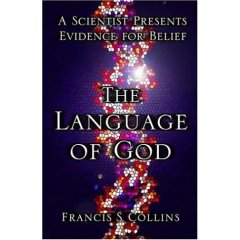
Book Review: The Language of God (Part 3)

The Language of God - A Scientist Presents Evidence for Belief
Francis S. Collins
New York: Free Press, a division of Simon and Schuster
2006

Collins spends the first 158 pages giving an account of his journey to faith and laying out the ground work for understanding where he is coming from as a Christian and a scientist. The methods of science are key to understanding (or misunderstanding) the issues involved in the conflict between science and faith.

There are scientists who step well outside their discipline when they promote a strong atheistic view, and assert flatly that there is no God. For a scientist steeped in the scientific method to assert a negative as though it were a fact, is not only illogical, it is unscientific.

But neither does Collins have much sympathy for Creationism -- "where faith trumps science." Augustine noted this problem 1600 years ago, and there are still people who prefer not to face observable fact because they are not able to reconcile what scientists report with how they understand scripture. Nowhere is this more obvious than with "young earth" creationists who believe that the earth and universe are about 6,000 years old or at most 10,000 years old. What of the fossil record? What of galaxies that measure as being well more than 10,000 light years distant? Are these misunderstandings of science or did God create the heavens and the earth with the appearance of great age in order to "test" us?

Intelligent Design -- "when Science Needs Divine Help" -- This does not get much support from Collins either. One of his major issues with ID is that, while it is couched in scientific terms, it was not developed in a scientific way. Scientific theories provide a framework for understanding how the natural world works, and in so doing, allows predictions to be made. Intelligent Design assumes that the gaps in understanding are able to be filled only by assuming a designer. Collins rightly points out that the danger here is that science can destroy such faith simply by filling in gaps in knowledge.

BioLogos -- "Science and Faith in Harmony." So where does this leave a Christian who wants to study the world scientifically? Collins finds "theistic evolution" satisfying. He lists 6 typical premises held by theistic evolutionists:
  1. The universe came into onto being out of nothingness, approximately 14 billion years ago.
  2. Despite massive improbablities, the properties of the universe appear to have been precisely tuned for life.
  3. While the precise mechanism of the origin of life on earth remains unknown, the process of evolution and natural selection permitted the development of biological diversity and complexity over very long periods of time.
  4. Once evolution got under way, no special supernatural intervention was required.
  5. Humans are part of this process, sharing a common ancestor with the great apes.
  6. But humans are also unique in ways that defy evolutionary explanation and point to our spiritual nature. This includes the existence of the Moral Law (the knowledge of right and wrong) and the search for God that characterizes all human cultures throughout history.
This view, according to Collins, is intellectually satisfying, plausible, and logically consistent -- and frees one to believe that God not only created the universe, but also the natural laws that govern it.

Collins employs the neologism "BioLogos" to describe theistic evolution from bios, the Greek word for "life" and logos, the Greek for "word". "BioLogos" has at once shed much of the "baggage" that creation, evolution, design, etc. have and further, "...expresses the belief that God is the source of all life and that life expresses the will of God."

I'm not convinced that inventing a word will create harmony where little is evident, but I'm not going to quibble. What is required is for the scientists to stop viewing people of faith as the enemy and visa versa. People of faith need to acknowledge that God, being outside space and time, is not bound by such human constraints. Scientists need to recognize that not all reality can be measured or reduced to a scientific model, and that if there is a God, then by definition God is outside the reach of the scientific method.

Collins' history as a medical geneticist and leader of the Human Genome Project demonstrates quite clearly that belief in God is totally consistent with practicing the scientific method. And conversely being a faithful Christian does not disqualify one from choosing the path of science to study the Universe. Collins has succeeded in both domains, and has written an engaging book that provides much to think about.

Wednesday, August 30, 2006

Book Review: The Language of God (Part 2)

The Language of God - A Scientist Presents Evidence for Belief
Francis S. Collins
New York: Free Press, a division of Simon and Schuster
2006

In Chapters 6-11 (Faith in Science, faith in God), Collins presents several options for how scientists can choose to engage spiritual matters:
  • Chapter 6 -- Genesis, Galileo, and Darwin
  • Chapter 7 -- Option 1: Atheism and Agnosticism (When Science Trumps Faith)
  • Chapter 8 -- Option 2: Creationism (When Faith Trumps Science)
  • Chapter 9 -- Option 3: Intelligent Design (When Science Needs Divine Help)
  • Chapter 10 -- Option 4: BioLogos (Science and Faith in Harmony)
  • Chapter 11 -- Truth Seekers
Chapter 6: Collins takes us on a short tour of the history of the conflict. Until people had the tools to observe and measure the world around them, it never occurred to anyone that Genesis could be anything but a literal account of the Universe and its creation. When such observers as Copernicus and Galileo began turning their intellect and primitive telescopes toward the heavens, they began to see patterns that could only be explained by a system of planets, moons, and stars that did not revolve around the earth, but moved in diferent ways, depending on their location and proximity to other objects. When the heliocentric model was proposed four our solar system Galileo ran into severe difficulties when he embraced it. He was forced to recant and spent the rest of his life under what amounted to house arrest. It took the Catholic Church until 1992 to finally and officially acknowledge that Galileo was innocent of heresy (althought to be fair, when the heliocentric model became obvious to even casual observers, the Church did not object during the intervening 350 years between Galileo's conviction and exoneration).

When Darwin published The Origin of Species in 1859, based on observations he made some 20 years previously, he also encountered opposition, (though not an Inquisition). He also encountered praise and admiration for coming up with what appeared to be a sound model for explaining how populations change genetically over time. As with astronomy, the theory proposed by Darwin ran counter to a particular interpretation of Scripture, and that controversy continues to this day.

In this section Collins quotes Augustine, who wrote 1600 years ago in a commentary on Genesis:
"...Now it is a disgraceful and dangerous thing for an infidel to hear a Christian. presumably giving the meaning of Holy Scripture, talking nonsense on these topics [motion and orbit of the stars, eclipses, biology, geology, etc.]; and we should take all means to prevent such an embarrassing situation, in which people show a vast ignorance in a Christian and laugh it to scorn. ..."
I wonder just what people were saying about planetary motion, eclipses, and biology that prompted Augustin to say such things....

Chapter 7: Collins discusses the problems with both points of view, and the inconsistencies each might present for a scientist. The term "agnostic" was coined by Thomas Henry Huxley ("Darwin's Bulldog") as a way to express the fact that he simply didn't know whether there was or was not a God. In a humorous anecdote involving Darwin and two atheists at a dinner party, Darwin expressed a preference for "agnostic" over "atheist" to describe his position. One of his guests replied "agnostic was but atheist writ respectable, and atheist was only agnostic writ agressive."

Certainly there is a continuum of degree within and between the two categories. A significant amount of space in chapter 7 is given to Richard Dawkins, representing the extreme of atheism. Dawkin's oft-quoted statement that "...faith is one of the worlds's great evils, comparable to the smallpox virus but harder to eradicate" is rebutted skillfully and without rancor.

Collins then turns to what he terms an "unlikely source", the late Stephen J. Gould, to demonstrate clearly the fundamental incompatibility between the dogmatic atheism of Dawkins and the proper use of science. Gould writes
"...To say it for all my colleagues and for the umpteenth millionth time: Science simply cannot by its legitimate methods adjudicate the issue of God's possible superintendence of nature. ..."
Gould continues with a list of evolutionary biologists, some of whom were his colleagues: Charles Darwin, George Gaylord Simpson, both agnostics; and Asa Gray, Charles Wolcott, and Theodosius Dobzhansky, all three devout Christians. This extended quote from Gould ends with this:
"Either half my colleagues are enormously stupid, or the science of Darwinism is fully compatible with conventional religious beliefs -- and equally compatible with atheism."
Having read a significant portion of Gould's popular articles and books, and a smaller, but not insignificant number of his scientific articles, I am not suprised that Gould held this belief. He was clearly an agnostic, but first and foremost he was a scientist who recognized that equally talented men and women could come to different conclusions than he as far as the spiritual realm was concerned.

Collins concludes chapter 7 with the statement that if science and its methods provide an accurate description of the physical and biological world, and there is truly a God, then they cannot contradict each other. Yet, these two "versions of truth" are at war, and mutual misunderstanding feeds the conflict.

Well, this second part of my book review has ended up being far longer than I intended, but I thought it important to cover Collins' basis for making his conclusions in the subsequent chapters.

Next: Creationism, Intelligent Design, and BioLogos (Collins' framework for allowing science and faith to live together in harmony)

Tuesday, August 29, 2006

Book Review: The Language of God (Part 1)


The Language of God - A Scientist Presents Evidence for Belief
Francis S. Collins
New York: Free Press, a division of Simon and Schuster
2006


Francis Collins is a medical geneticist who has spent his professional life trying to understand what goes wrong in certain diseases. His early research into the "typo" in the genetic code that leads to cystic fibrosis led to his being invited to lead one of the teams that engaged in a "race" to decode the human genetic code.

He is also a Christian whose path took him through agnosticism, through atheism, and finally faith after he was challenged to read Mere Christianity by C.S. Lewis. He found himself questioning the things he thought he knew.

The Language of Life in divided into three parts:
  • Part 1: Chapters 1-2 -- The Chasm Between Science and Faith
  • Part 2: Chapters 3-5 -- The Great Questions of Human Existence
  • Part 3: Chapters 6-11 -- Faith in Science, Faith in God
An appendix discusses issues of medical bioethics and the moral practice of science.

The first part discusses his personal journey to faith with many personal reflections on what went through his mind as he grew up. His parents were quite instrumental in laying the groundwork for his educational and social development. Much of his growing years were spent involved in organic farming, music, and summer theater. Collins chose a different path than his somewhat counter-cultural parents as far as faith is concerned, but nonetheless he dedicated his book to his parents.

In the second part, Dr. Collins discusses the science that is involved, and why it is necessary to know and understand the genetic code in order to understand how genetic disease can be treated. In addition he tells a fascinating story of two competing groups who were in a race to decode the human genome, one publically funded and the other privately funded. One group was dedicated to rapid disemination of the results, and the other was interested in a return on the investment of the private parties who underwrote the research.

As both groups converged on the goal of decoding the human genome, Francis Collins had a nightime meeting with Craig Venter, his counterpart on the privately-funded side, that was arranged by a mutual friend. The meeting took place in the basement of the friend's house over pizza and beer. It almost seems "cloak-and-dagger", and in a way it was. An inquisitive reporter could have blown the whole thing out of the water and eliminated any hope of cooperation between the two groups. As it turned out, the two team leaders appeared jointly at a White House Press Conference on June 26, 2000 to announce the completion of the task.

Francis Collins is a quirky individual, and often brings a guitar to meetings. It is hard to imagine a room full of scientists singing along to a ballad about genetic research written to familiar music, but it seems to happen on a regular basis where Collins is involved. Having personally been involved with science for many years myself, I think we could use more scientists who actually have a life....

In the next two installments of this three part review, I will focus in on Collins' assessment of different ways one can bring their worldview to bear on science and religion, and the pitfalls involved with most of them. His groundwork in the nature of science that he lays in the first two parts will serve the reader well as he discusses atheism/agnosticim, creationism, and intelligent design, as well as his own proposal for a framework for understanding the relationship of science and faith.

Tommorow: Chapters 6-10 on the often uneasy relationship between science and faith

Thursday, August 17, 2006

Mine Eyes Have Seen the Gory - Christianity Today Magazine

Mine Eyes Have Seen the Gory - Christianity Today Magazine:
Two historians tell why Christian thought went AWOL during the civil war.
Reviewed by Elesha Coffman | posted 08/17/2006 09:30 a.m.

"Historians have a formidable task when they try to explain why something happened. The task becomes even harder when they ask why something did not happen. Undaunted, Mark Noll and Harry Stout take this more difficult tack in their new books on the Civil War: Why did American Christians not think more deeply or act more ethically as the country faced bloody sectional conflict?

This type of history first requires demonstrating that the non-event could and should have occurred. Both authors identify moral voices crying in the wilderness—Abraham Lincoln (though he could be hard-hearted as well as humble), a few circumspect pastors and journalists, even Union Gen. George McClellan (Stout does not ascribe his infamous reticence to incompetence but to observance of the rules of limited war). Noll also brings in the never before studied perspectives of Europeans, Catholic and Protestant, who more clearly saw the flaws in American thinking about slavery, warfare, theology, and biblical interpretation. Stout cites the centuries-old Christian tradition of just-war theory. ..."
Here is a book review of two treatments of the role of theological thought in the years leading up and during the Civil War. Mark Noll is known to me, as I have read two of his books, but Harry Stout is not familiar to me. I look forward to reading both books, as they bring together two loves of mine: Theology and Civil War history.

Having read a number of histories and biographies relating to the Civil War, it has become obvious to me that what I learned in school was not necessarily the way it was. But this review by Elesha Coffman indicates that there is much more to learn and understand about this tragic episode in our history.


The Civil War as a Theological Crisis (The Steven and Janice Brose Lectures in the Civil War Era)
by Mark A. Noll


Upon the Altar of the Nation : A Moral History of the Civil War
By Harry S. Stout


Technorati tags: ,

Saturday, May 27, 2006

Book Review: The Presbyterian Handbook


The Presbyterian Handbook
Geneva Press (2006)
List Price: $14.95
Amazon.com: $10.17 (as of May 27, 2006)

There was a box of these hip-pocket-sized books at the May 16 meeting of the Presbytery of Missouri Union. I was intrigued, and at $10 a copy I didn't have to think too long about it.

This short volume is written for "...Presbyterian youth, adults, students, families, and all those interested in learning about much of what encompasses life in the church."

Along with such practical suggestions as "How to Stay Alert in Church" (if all else fails, pinch yourself), "What to Bring to a Church Potluck by Region" (tofu is big on the West Coast), and "How to Avoid Getting Burned at the Stake" (one suggestion is to avoid public heresy), there are serious sections on Church and Presbyterian history, including what it is that defines us as Reformed Christians and Presbyterians and those much-maligned and often-misunderstood beliefs about predestination. Here, according to this book, is what predestination is NOT (page 117):
  • Fatalism. "It makes no difference what I do if I'm not predestined by God for salvation."
  • Determinism. "I have no real choices to make in life and no freedom because my life has been predestined."
  • An excuse to live it up. "Since I don't know if I am among the elect, I might as well just do what I want and enjoy myself in life."
  • An excuse to coast along. "I'm a member of the church, so I must be 'elect'. I can coast along in life doing as I please, since my salvation is assured."
  • An excuse not to spread the gospel. "If God has already determined who will be saved, there is no need to preach the Gospel."
It goes on to describe what predestination IS, and how to explain it to your friends. There is a prominent disclaimer in this section that "it may take multiple readings -- and time -- to understand this concept."

Much of the book is in the form of lists -- ten Bible heroes, sixty essential Bible passages, the five wierdest laws, and so forth.

The list of ten Bible villains contains the usual suspects -- Satan, Judas, Jezebel -- but also includes God's People with this explanation:
"They whine, they sin, they turn their backs on God over and over again. When given freedom, they blow it. When preached repentance by God's prophets, they stone them. When offered a Savior, we kill him. In the end, it must be admitted, God's people -- us! -- don't really shine. Only by God's grace and the gift of faith in Jesus Christ do we have hope." -- page 136
And then there are the five grossest stories.... On second thought, let's not go there. Teenage boys will love it, though. And they will turn to their Bibles.

Overall I found this book to be engaging, informative, witty, and serious. It could be used well in confirmation classes, but I suspect that many adults would find things in The Presbyterian Handbook that they didn't already know. It is well worth reading.