Showing posts with label fly fishing. Show all posts

Wednesday, April 11, 2012

Estimate of fish killed at Flat Branch increases to 14,000 - Columbia Missourian

Estimate of fish killed at Flat Branch increases to 14,000 - Columbia Missourian

"COLUMBIA — The estimated number of fish killed in Flat Branch Creek last week has skyrocketed from an initial estimate of 1,000 to 14,000. ..."

A lot of water was used to drown a fire that involved a lot of toxic liquids (an auto parts store as well as a beauty supply store and Chinese restaurant.  The Flat Branch flows into the Hinkson Creek and ultimately to the Missouri River.

The city of Columbia is already dealing with an EPA mandate to mitigate problems with the Hinkson, but when the watershed has so much impervious surface, it is really difficult to maintain water quality standards.

Tuesday, June 30, 2009

It’s Now Legal to Catch a Raindrop in Colorado - NYTimes.com

It’s Now Legal to Catch a Raindrop in Colorado - NYTimes.com:
"DURANGO, Colo. — For the first time since territorial days, rain will be free for the catching here, as more and more thirsty states part ways with one of the most entrenched codes of the West.

Precipitation, every last drop or flake, was assigned ownership from the moment it fell in many Western states, making scofflaws of people who scooped rainfall from their own gutters. In some instances, the rights to that water were assigned a century or more ago. ..."
Anglers have been familiar with the morass of water laws in the western states for some time, as they deal with streams that run dry during the best months for fishing because upstream impoundments refuse to release even a minimal flow. Politics and economics clash with human and environmental needs to the point where silly laws, like the ones that were superseded by Colorado's recent action, made technical criminals of many landowners.

Monday, September 08, 2008

A Fun Weekend...

Every year the Boy Scout troop at my church goes on a campout called "Aqua Bumming". We stay for two days in cabins down at the Lake of the Ozarks, and run 50-60 boys through a variety of waterfront skills, including canoeing, sailing, rowing, swimming, fishing, and fly fishing.

A fellow scout leader and I taught seven boys who learned knots, how to tie flies, casting, and a variety of other skills that go into fishing with artificial flies. Then we went down to the lake shore and turned the boys loose with rods and reels graciously supplied by the Mid-Missouri Chapter of Trout Unlimited (both of us are also members of these organizations).

Starting off with the flies they tied themselves, the boys cast off the shore and some of them waded up to their waists. It was a good day for novice casters -- no wind to speak of and no one got into major difficulties with snags or knotted leaders. The major problems were the wakes from the powerboats that went by on regular intervals as well as the fact that we really weren't fishing in good habitat.

In spite of all that, four of the boys caught bluegill on the flies they tied themselves. Most of the boys had caught fish before on bait and spincast rods, but catching a fish with a fly rod was definitely a thrill for them, and doubly so because it was on a fly they tied themselves.

We'll be taking the boys to a farm pond near Columbia to finish the merit badge. The fish there don't get a lot of angling pressure, so they should get a chance to catch both bluegill and bass on a fly rod.

Monday, March 05, 2007

Presbyterian News Service: Ministry tries making fishers of men

Presbyterian News Service: Ministry tries making fishers of men
"HUNTSVILLE, AL — Jesus called his first disciples away from their fishing nets, but a new group in Madison County is calling Christians and seekers down by the riverside.

Flyfishers of Men, a fairly informal school of new and experienced flyfishers, both men and women, believe that the practice of wading into beautiful streams, fly rod in hand, can help a person catch more than fish. ..."

I get altogether too few opportunities to get out into clear streams, but I treasure it every time. Kay Campbell of Religion News Service has captured much of the allure of fly fishing in this article picked up by Presbyterian News Service.

Fishing with artificial flies slows you down. You see things you might not ordinarily see. Herons, kingfishers, beavers, minks, even otters are regular denizens of my favorite spring-fed creek. There is plenty of time for contemplation, and the natural beauty of the creek and its watershed provide an atmosphere that leads me inexorably to a sense of God's presence.

I know that God is present in all the activities and locations of life, but I have to say that getting away from the day-to-day distractions, even if it is only for a day, is a spiritually rejuvenating experience for me.

One of my favorite books is "A River Runs Through It" by Norman Maclean (1902-1990. It was made into a pretty good movie in 1992, but the book (as is often the case) is far better. It starts off like this:
"In our family, there was no clear line between religion and fly fishing. We lived at the junction of great trout rivers in western Montana, and our father was a Presbyterian minister and a fly fisherman who tied his own flies and taught others. He told us about Christ's disciples being fishermen, and we were left to assume, as my brother and I did, that all first-class fishermen on the Sea of Galilee were fly fishermen and that John, the favorite, was a dry-fly fisherman. ..."

Maclean, who was an English professor at the University of Chicago, wrote with great sensitivity about his family, Montana, his experiences working for the US Forest Service and various other topics.

I gotta get out there and fish......

Monday, August 14, 2006

The Reformed Angler Angling

Jn 21:1 Afterward Jesus appeared again to his disciples, by the Sea of Tiberias. It happened this way: 2 Simon Peter, Thomas (called Didymus), Nathanael from Cana in Galilee, the sons of Zebedee, and two other disciples were together. 3 “I’m going out to fish,” Simon Peter told them, and they said, “We’ll go with you.” So they went out and got into the boat, but that night they caught nothing.

As I mentioned a couple weeks ago, fishing and family vacations are not easy to mix together, but we decided that Friday was the day I was going to fish. Accordingly, on Wednesday I visted the Snake River Angler in Moose Wyoming (just outside the south entrance to Grand Teton National Park) and started asking for advice.

Since anglers are the bread and butter for such businesses, I bought flies as I was asking questions. The man who helped me was quite forthcoming with information, and dissuaded me from my original plan, which was fo fish Leigh Lake (north of Jenny Lake). His advice was to try the area where Cascade Creek goes into Jenny Lake, and then try Cottonwood Creek, the outlet to Jenny Lake.

All the while he was talking, he was adding flies to my pile, and I was able to stop at two dozen -- which was quite enough. My son added a t-shirt to the pile, and attempted to slip in a few other items, mostly with sharp edges. I went for the shirt, but the knives stayed at the store.

I bought a one day license for Friday, and in the morning of August 11, I got up at 6 am and walked to the boat dock for the early-bird ferry across the lake to the Cascade Canyon trailhead. Jenny Lake is a glacially-scoured basin, thus is quite deep (over 250 feet) with a steep dropoff. Where Cascade Creek comes in, it is fairly shallow, though, and I could wade it comfortably. Well, the scenery was great, and the kingfishers were out and about, but I didn't even SEE a fish let alone get one to take second look at my flies, so I took the ferry back about 9:30 am and Susan, Liam, and I piled into the car and drove down to one of the stream accesses to Cottonwood Creek.

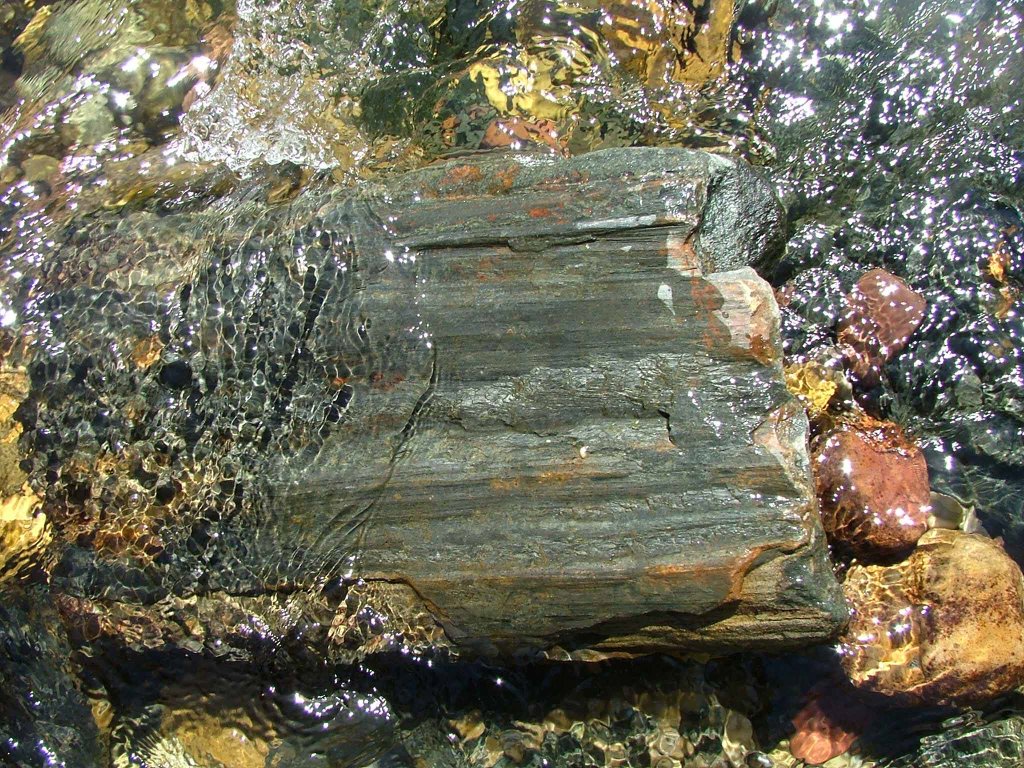
A piece of petrified wood in Cottonwood Creek

The stream bed of Cottonwood Creek where I fished consisted of large glacial cobblestones between 4 and 12 inches in diameter (or larger). They were slick and rolled easily (you can see where this is heading...) Susan sat on a rock near the creek while I gingerly waded out to where I could cast to likely spots.

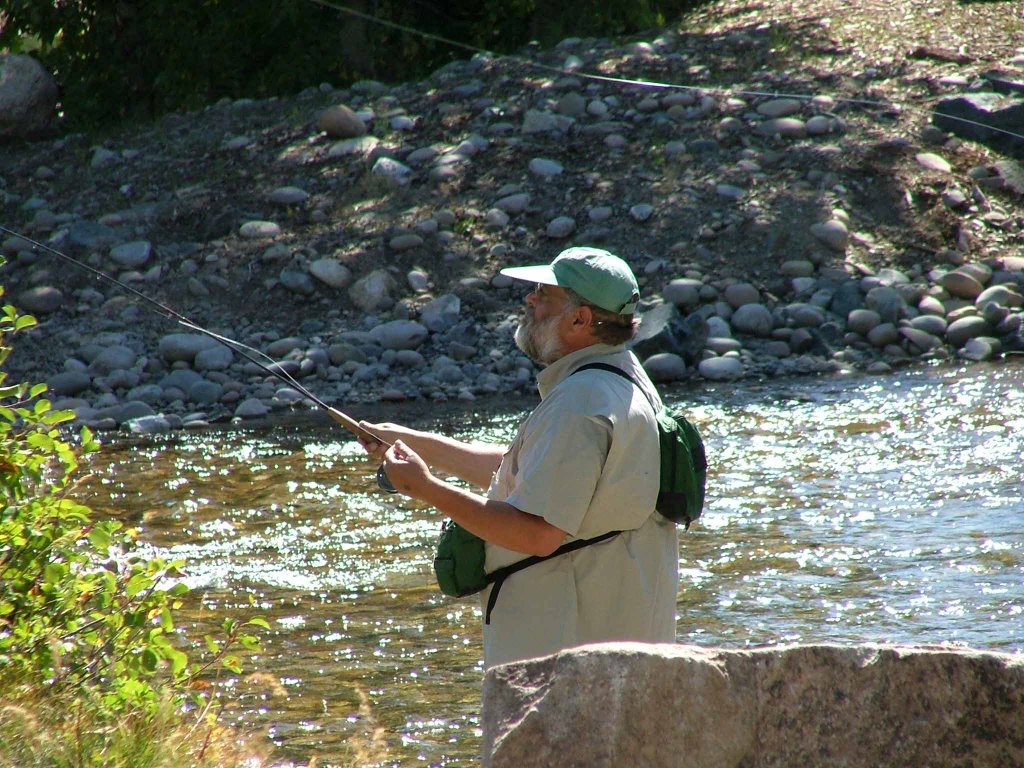
I cast upstream and let the fly drift down. There were a number of belly flashes, indicating that a trout had been interested enough to take a second look, but it seemed they were not interested enough to take the offering. At least they were looking up... I tried letting the fly drift past me and downstream near the concrete supports for the one-lane bridge. This was a bit more productive, as I felt a strike. I turned so I could play the fish more comfortable, and the cobbles rolled beneath my feet. I fell and landed on my side in the creek, but I had the presence of mind to make sure I didn't fall on my rod. Susan, who had been taking lots of pictures, somehow failed to record my undignified posture for posterity.
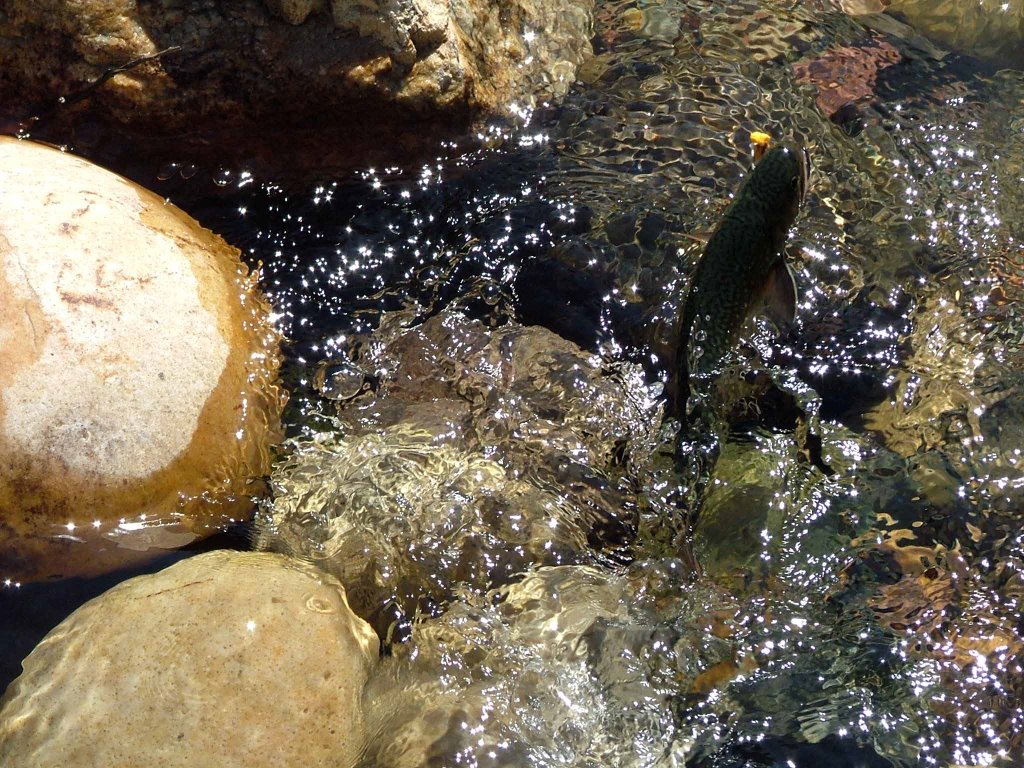
When I got up, I picked up the rod, and to my surprise, the trout was still on. I played it quickly, and as I took it in my hand, it squirmed and took off expeditiously for cover. It was a nice brook trout, about 8 inches.

I kept on fishing at that location, and played 4 more fish (or maybe the same fish 4 times), but these managed to unhook themselves. Or as fly anglers prefer to put it, these were LDRs (long distance releases). In any case, it was nice to be able to fish, and I decided to call it a good day, and we went back to camp and had lunch.

Wyoming (whose laws govern fishing in Grand Teton National Park), is trying to restore native cutthroat trout, and has a special bonus limit on brookies, and I was actually looking forward to helping in that process. My major disappointment though, was that I didn't catch any cutthroats. My fishing preferences tend toward small streams and native trout, and these are often at odds with the management practices. There are cutthroat trout, brook trout, rainbow trout, brown trout, and lake trout to be had in the various waters of Grand Teton and Yellowstone National Parks. Of all these trout, only the cutthroat are native, and when the Lewis and Clark expedition passed near this area 200 years ago, that was what they caught and ate.

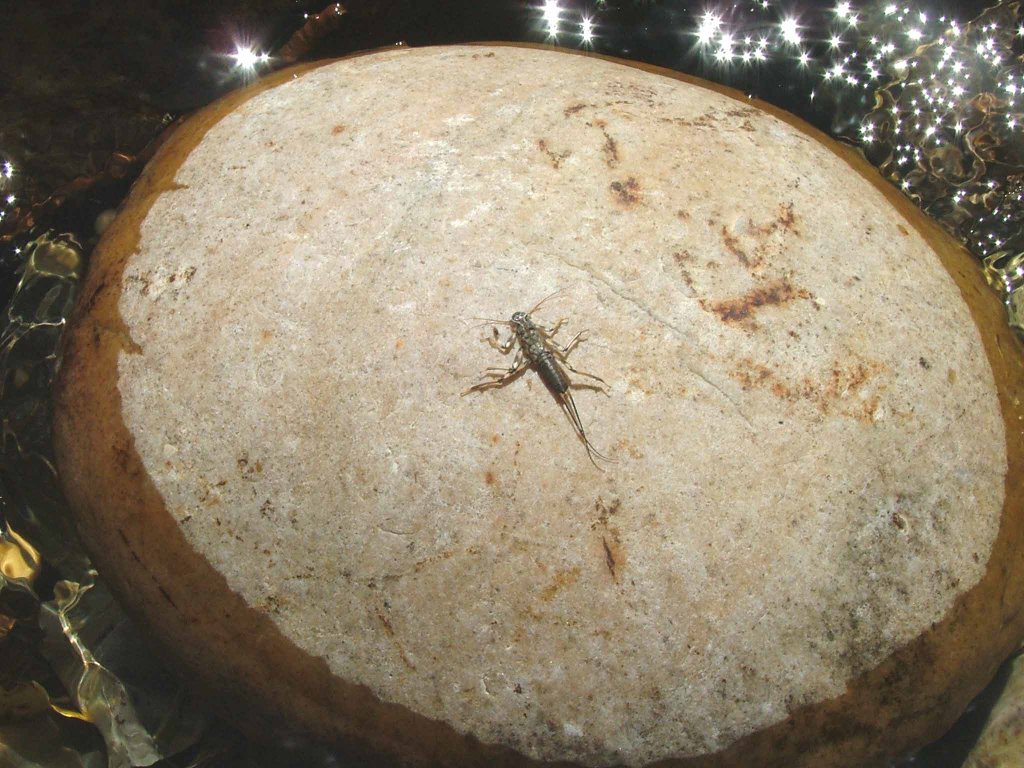
An indicator of what was on the trout's menu

Unfortunately (in my opinion), state fisheries managers had catered to the wishes of anglers to catch large fish and a lot of them, and stocking programs have imported non-native trout to fill this perceived need. It is good to see the state of Wyoming working with the National Park Service to restore the native fish, and I hope they are successful.

It was a great pleasure to fish on Friday, especially in an area of such beauty, and I hope I can fsh more. It is such a relaxing way to spend time.

All photos in this posting were taken by my wife, Susan Melia-Hancock

Thursday, July 27, 2006

Getting Psyched For Vacation

In a little over a week, my wife, son, and I will get into the car and start heading west with the intention of being at the Lizard Creek Campground of Grand Teton National Park in time to select our home for the next 6 nights. Personally, I am hoping for good shade, and a view of the Northern shore of Jackson Lake.

We'll use this location as a base for day trips into the Yellowstone National Park and the surrounding areas. The entry fee is good for both parks, and we may just pick up a Golden Eagle Passport that will pay the entry fees at most US fee areas.

Cameras and walking staffs will be an important part of our week, and I have perrmission to take some time for fly fishing. Mixing fishing and family vacation is a dicey proposition, and some anglers of my acquaintance just don't do it. Fly fishing is pretty much a solitary activity, and family vacations are, well, a family activity...

The Wyoming non-resident angling fees are, to my Missourian sensibilties, pretty outrageous at $11/day, but fishing in Yellowstone requires only a Yellowstone permit at $20/week. Of course, I am looking at one or two days of fishing, tops, so I may try out the Grand Tetons one day and Yellowstone another day.

I took stock of my flyboxes and I am pretty well fixed for flies, although I plan to tie up a few more before I go.

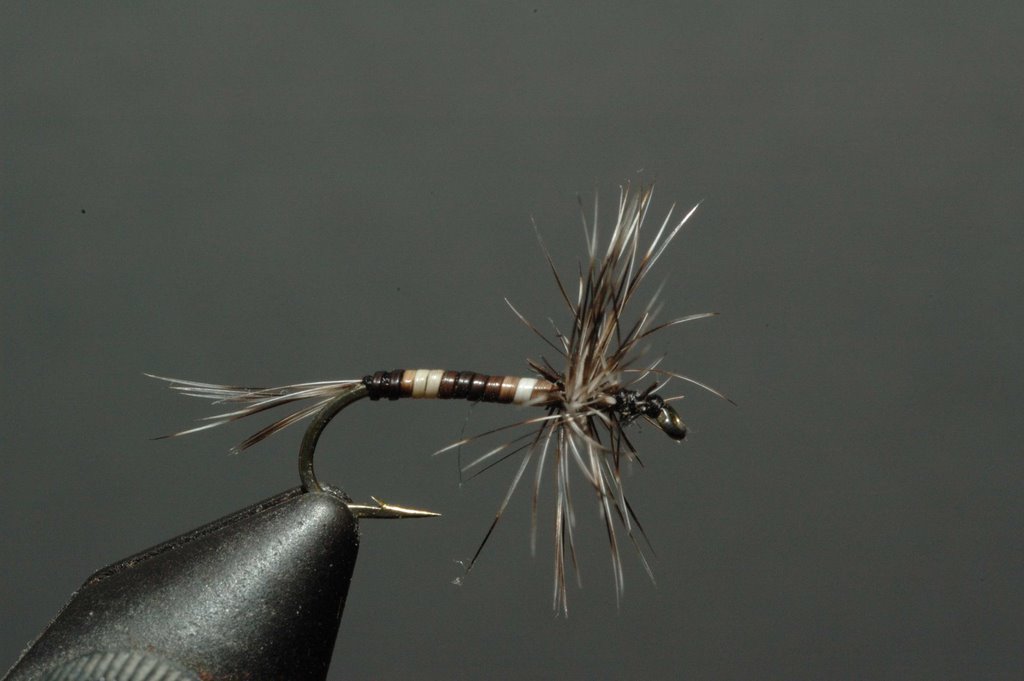
Missouri flies tend to be pretty sparse with the materials:
This fly has no name, but is tied with javelina bristles and grizzly hackle.

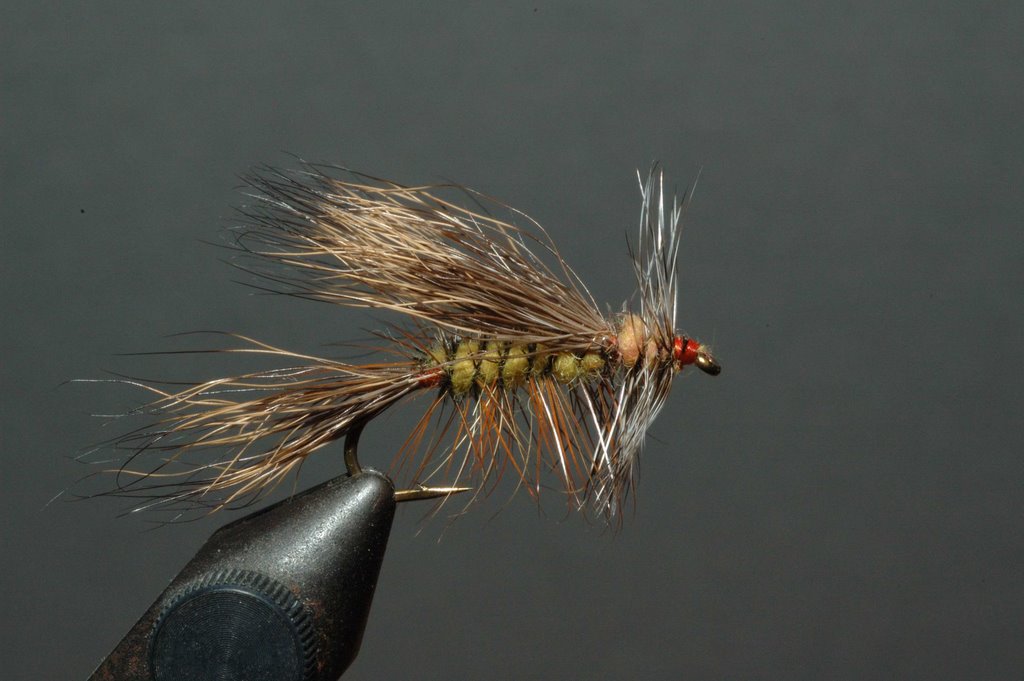
Western flies tend to be large and fuzzy:
Stimulator

Here is my version of large and fuzzy:

Adams Wulff

And if the caddis flies are out and about, here is a pretty simple, yet effective fly:

CDC Caddis

CDC stands for cul de canard and refers to the feathers around a duck's preen gland. These are naturally water-resistant, thus these flies float nicely.