Twitter / @CivilWarwp/Tweeting the Civil War:
The Washington Post is tweeting the Civil War, using the words of contemporary observers. It looks like you can get tweets by following the discussion or simply navigate to the linked page to read these short messages.
Showing posts with label Civil War. Show all posts
Showing posts with label Civil War. Show all posts
Sunday, January 02, 2011

Thursday, November 19, 2009
A "Few Appropriate Remarks"
 On this day in 1863 people gathered at a location near Gettysburg, Pennsylvania to dedicate a cemetery to hold the remains of soldiers who had died in this decisive battle. Abraham Lincoln was invited to make a "...few appropriate remarks..." following the oration which was to be delivered by Edward Everett.
The oration lasted some two hours and was, by contemporary accounts, every bit as impressive as Everett's reputation as a speaker would have predicted. Then Lincoln spoke for about two minutes, saying the following:
"Four score and seven years ago our fathers brought forth, on this continent, a new nation, conceived in Liberty, and dedicated to the proposition that all men are created equal.This version of the Gettysburg Address is known as the "Bliss copy" and of all the versions and drafts of this speech was the only one signed by Abraham Lincoln.
Now we are engaged in a great civil war, testing whether that nation, or any nation so conceived and so dedicated, can long endure. We are met on a great battle-field of that war. We have come to dedicate a portion of that field, as a final resting place for those who here gave their lives that that nation might live. It is altogether fitting and proper that we should do this.
But, in a larger sense, we can not dedicate—we can not consecrate—we can not hallow—this ground. The brave men, living and dead, who struggled here, have consecrated it, far above our poor power to add or detract. The world will little note, nor long remember what we say here, but it can never forget what they did here. It is for us the living, rather, to be dedicated here to the unfinished work which they who fought here have thus far so nobly advanced. It is rather for us to be here dedicated to the great task remaining before us—that from these honored dead we take increased devotion to that cause for which they here gave the last full measure of devotion—that we here highly resolve that these dead shall not have died in vain—that this nation, under God, shall have a new birth of freedom—and that government of the people, by the people, for the people, shall not perish from the earth."
The world did not "long remember" Edward Everett's words, worthy though they were, but Lincoln's brief remarks are recognized to this day.
The photograph that accompanies this posting is from the Wikipedia article on Abraham Lincoln, and is in the public domain.
Thursday, January 29, 2009
RNS Feature: "200 years later, Lincoln’s faith remains an enigma"
RNS Feature: "200 years later, Lincoln’s faith remains an enigma":
As far as Abraham Lincoln's theology was concerned, there is little to quibble as far as it went. His understanding about God's will and how it is distinct from human will remains a model for us today. The excerpt I quoted above does not do Lincoln justice, so I recommend you read his full Second Inaugural Address. It isn't long, and his exposition on Divine Will is in the third of the four paragraphs.
When Licoln delivered this speech on March 4, 1865, he had only about a month left to live, and the Civil War was winding down. The final thoughts in his address outlined his intention to see the nation's wounds bound up and start the healing process. His assassination left a void that was filled with people who were not as concerned with healing as much as with retribution. This is one of the great "what ifs" of history.
"WASHINGTON—Seven score and four years ago, Abraham Lincoln stood on the steps of the U.S. Capitol and said North and South alike must suffer for the sin of slavery.This is not really new to people who have read history, although it is a fact that when Lincoln attended services, it was often in a Presbyterian congregation.
“If God wills that (the war) continue until ... every drop of blood drawn with the lash shall be paid by another drawn with the sword, so it still must be said `the judgments of the Lord are true and righteous altogether,”’ Lincoln said in his second inaugural address, quoting the Psalms.
Called “Lincoln’s Sermon on the Mount,” his 1865 address has been deemed the most religiously sophisticated presidential speech in American history. It was delivered by a backwoods lawyer with just one year of formal schooling who never joined a church. ..."
As far as Abraham Lincoln's theology was concerned, there is little to quibble as far as it went. His understanding about God's will and how it is distinct from human will remains a model for us today. The excerpt I quoted above does not do Lincoln justice, so I recommend you read his full Second Inaugural Address. It isn't long, and his exposition on Divine Will is in the third of the four paragraphs.
When Licoln delivered this speech on March 4, 1865, he had only about a month left to live, and the Civil War was winding down. The final thoughts in his address outlined his intention to see the nation's wounds bound up and start the healing process. His assassination left a void that was filled with people who were not as concerned with healing as much as with retribution. This is one of the great "what ifs" of history.
Tuesday, October 09, 2007
TCS Daily - A Lesson for Our Time
TCS Daily - A Lesson for Our Time:
Read the article, and if you feel moved to do so, comment on it. Keep it civil.
"In August 1864, less than three months before the election, Republican leaders visited President Lincoln at the White House and told him that he had no hope of re-election. Their canvassing indicated that the country was so weary of the war that the Democratic candidate would triumph easily. Some Republicans were urging the President, for the sake of the party, to give up the party's nomination—which had been conferred only two months earlier—so a stronger candidate could be nominated. 'Mr. Lincoln is already beaten,' wrote Horace Greeley, the famous Republican editor of the New York Tribune. 'He cannot be elected. And we must have another ticket to save us from utter overthrow. If we had a ticket as could be made by naming Grant, Butler, or Sherman for President, we could make a fight yet.'..."For those tempted to draw parallels between 1864 and 2007 (and beyond), keep in mind that the events of the Civil War are a matter of historical fact, and current events are unfolding even as I type this brief comment.
Read the article, and if you feel moved to do so, comment on it. Keep it civil.
Monday, June 18, 2007
The Christian Century: Untribal God
The Christian Century: Untribal God:
While I agree with John M. Buchanan's assessment of the importance of Lincoln's speeches and the Second Inaugural in particular, I find his favorable citation of Ronald C. White's statement that Lincoln was "inveighing against a tribal God ... and building a case for an inclusive God" to be questionable. I do not think this was what Lincoln was attempting to do. Our 16th president seems to have had no difficulty with the idea that God knew right from wrong. It was just figuring out which side that was that was the problem.
An important clue is found in a hand-written note Lincoln wrote in 1862, probably just before the battle of Antietam. His secretary, John Hay, found it as he was packing Lincoln's effects following his assassination. Hay titled it "Mediation on the Divine Will", and its themes were incorporated into the Second Inaugural Address delivered in March of 1865:
"The Second Inaugural contains Lincoln's notable words about the war: 'Both sides read the same Bible,' Lincoln said, 'pray to the same God and each invokes His aid against the other. . . . The prayers of both could not be answered: that of neither has been answered fully.' White says that Lincoln was 'inveighing against a tribal God' who would take the side of one part against the other, 'and building a case for an inclusive God.'"I saw this linked today in Presbyweb and was intrigued enough to follow the link and read the entire article. It's fairly short and is a history of Lincoln's Second Inaugural Address and the relationship Lincoln had with the Presbyterian Church leading up to that speech.
While I agree with John M. Buchanan's assessment of the importance of Lincoln's speeches and the Second Inaugural in particular, I find his favorable citation of Ronald C. White's statement that Lincoln was "inveighing against a tribal God ... and building a case for an inclusive God" to be questionable. I do not think this was what Lincoln was attempting to do. Our 16th president seems to have had no difficulty with the idea that God knew right from wrong. It was just figuring out which side that was that was the problem.
An important clue is found in a hand-written note Lincoln wrote in 1862, probably just before the battle of Antietam. His secretary, John Hay, found it as he was packing Lincoln's effects following his assassination. Hay titled it "Mediation on the Divine Will", and its themes were incorporated into the Second Inaugural Address delivered in March of 1865:
"The will of God prevails. In great contests each party claims to act in accordance with the will of God. Both may be, and one must be, wrong. God cannot be for and against the same thing at the same time. In the present civil war it is quite possible that God's purpose is something different from the purpose of either party--and yet the human instrumentalities, working just as they do, are of the best adaptation to effect his purpose. I am almost ready to say this is probably true--that God wills this contest, and wills that it shall not end yet. By his mere quiet power, on the minds of the now contestants, He could have either saved or destroyed the Union without a human contest. Yet the contest began. And having begun He could give the final victory to either side any day. Yet the contest proceeds."Lincoln showed a great deal of humility, wisdom, and discernment in trying to determine the will of God. God could not be for and against slavery; he had to be one or the other. God is not neutral on moral issues. We may not see things as clearly as we might; Lincoln knew that and was willing to concede that he might misconstrue the will of God in whole or in part.
Monday, April 09, 2007
Appomattox -- April 9, 1865
 The day that would later be remembered as the end of the Civil War (to be accurate, it wasn't, as there were still several armies in the field) began with an assault by the Confederate Second Corps on Union positions. It was Palm Sunday, 1865.
While the initial charge forced the Union lines to retreat, it also put the Confederates in a position to view the Union XXIV Corps and the V Corps in battle formations. The CSA Second Corps withdrew and a member of General Robert E. Lee's staff was given a report to take back to Lee's headquarters.
There had been contacts between General Lee and General Ulysses S. Grant for a few days already, but Lee had not been ready to surrender. What he heard from his staff officer the morning of the 9th was enough to force his decision. He made contact with Grant's headquarters and a meeting was agreed to. The Confederates secured a home in the area and Lee awaited Grant.
 After some reminiscing about their shared experiences in the Mexican War, Lee, who was perhaps a little impatient to conclude what must have been a humiliating visit, asked Grant to proceed to the matter at hand. Grant reiterated, in writing, generous terms:
"In accordance with the substance of my letter to you of the 8th inst., I propose to receive the surrender of the Army of N. Va. on the following terms, to wit: Rolls of all the officers and men to be made in duplicate. One copy to be given to an officer designated by me, the other to be retained by such officer or officers as you may designate. The officers to give their individual paroles not to take up arms against the Government of the United States until properly exchanged, and each company or regimental commander sign a like parole for the men of their commands. The arms, artillery and public property to be parked and stacked, and turned over to the officer appointed by me to receive them. This will not embrace the side-arms of the officers, nor their private horses or baggage. This done, each officer and man will be allowed to return to their homes, not to be disturbed by United States authority so long as they observe their paroles and the laws in force where they may reside."
-- The Personal Memoirs of Ulysses S. Grant. Old Saybrook, CT: Konecky and Konecky. Reprint of the 1885 edition in one volume.
 After some discussion, during which Lee pointed out that many enlisted cavalrymen provided their own horses, Grant agreed that, in view of the needs of the planting season, they would be permitted to retain their horses as with the officers. Lee thanked Grant, saying that this would have a good effect on the soldiers.
When the surrender was concluded, cheering commenced in the Union camps. General Grant ordered an immediate stop on the grounds that this sort of humiliation was uncalled for.
The following day Brigadier General Joshua Chamberlain was selected to receive the fomal surrender of the Confederate Army of Northern Virginia. Chamberlain, who was a professor at Bowdoin College before the Civil War, chose on his own authority to show military respect to the Confederate forces which were passing in review as they proceeded to the point where they would stack their arms. In Chamberlain's words:
"... Instructions had been given; and when the head of each division column comes opposite our group, our bugle sounds the signal and instantly our whole line from right to left, regiment by regiment in succession, gives the soldier's salutation, from the "order arms" to the old "carry"—the marching salute. Gordon at the head of the column, riding with heavy spirit and downcast face, catches the sound of shifting arms, looks up, and, taking the meaning, wheels superbly, making with himself and his horse one uplifted figure, with profound salutation as he drops the point of his sword to the boot toe; then facing to his own command, gives word for his successive brigades to pass us with the same position of the manual,—honor answering honor. On our part not a sound of trumpet more, nor roll of drum; not a cheer, nor word nor whisper of vain-glorying, nor motion of man standing again at the order, but an awed stillness rather, and breath-holding, as if it were the passing of the dead!..."
-- The Passing of the Armies by Joshua Lawrence Chamberlain, originally published in 1915

Chamberlain knew this would be a controversial decision on his part, but his simple act of consideration may have eased the tensions of the day.
General Gordon, who began the previous day with what he quickly learned would be a futile assault on Union lines, was moved by this display of courtesy, and later mentioned Chamberlain's gesture in his memoirs.
As a result of the surrender of the Army of Northern Virginia, the remaining Confederate armies surrendered, beginning with General Joseph Johnston's army in North Carolina on April 26, followed by the Trans-Mississippi Department under the command of General Edmund Kirby Smith on June 2, 1865. The last significant Confederate force, under the command of General Stand Watie, a Cherokee, took place in Oklahoma on June 23, 1865.
On Good Friday, 1965 (April 14, 1865), Abraham Lincoln attended a play at Ford's Theater and received a fatal wound from an assassin's pistol. His Second Inauguaral Address, delivered a little over a month previously, set the tone for his intentions in reconstruction:
"... Fondly do we hope — fervently do we pray — that this mighty scourge of war may speedily pass away. Yet, if God wills that it continue, until all the wealth piled by the bond-man's two hundred and fifty years of unrequited toil shall be sunk, and until every drop of blood drawn with the lash, shall be paid by another drawn with the sword, as was said three thousand years ago, so still it must be said "the judgments of the Lord, are true and righteous altogether."
With malice toward none; with charity for all; with firmness in the right, as God gives us to see the right, let us strive on to finish the work we are in; to bind up the nation's wounds; to care for him who shall have borne the battle, and for his widow, and his orphan — to do all which may achieve and cherish a just and lasting peace, among ourselves, and with all nations."
Had Lincoln lived, things might have been significantly different...
All photos are believed to be in the public domain and were obtained from Wikipedia.
While I have linked liberally with Wikipedia in this posting, I crosschecked with such works as Grant's The Personal Memoirs of Ulysses S. Grant, Chamberlain's The Passing of the Armies, McPherson's Battle Cry of Freedom, and Shelby Foote's The Civil War: a Narrative - Red River to Appomattox.
Wednesday, October 18, 2006
Short Review: The Civil War as as Theological Crisis
 The Civil War as a Theological Crisis
Mark A. Noll
Chapel Hill: The University of North Carolina Press
2006
ISBN: 0-8078-3012-7
The first impression I had of this book was its cover-- at once a compelling image and a perplexing image. The inside back cover identifies it as the Lutheran church on Main Street, Sharpsburg, Maryland. The date is September 1862. On September 17, 1862 the Battle of Antietam was fought there on a single day with 45,000 Confederate troops of the Army of Northern Virginia under Robert E. Lee and 87,000 Federal soldiers of the Army of the Potomac commanded by George McClellan. When the day was over, there were nearly 23,000 casualties split nearly evenly between North and South -- the bloodiest single day in the history of American wars. This may have been a "draw" in military terms, but Lee and his army were permitted to retreat unchallenged back across the Potomac River. Many historians believe the war could have ended right there had McClellan pressed his advantage and forced the surrender of the Army of Northern Virginia.
But I digress...
My first thought when I saw the cover with its mirrored image of the church was Lincoln's speech on accepting the nomination for US Senator from Illinois in 1858:
"...A house divided against itself cannot stand." I believe this government cannot endure, permanently half slave and half free. I do not expect the Union to be dissolved -- I do not expect the house to fall -- but I do expect it will cease to be divided. It will become all one thing or all the other. Either the opponents of slavery, will arrest the further spread of it, and place it where the public mind shall rest in the belief that it is in the course of ultimate extinction; or its advocates will push it forward, till it shall become alike lawful in all the States, old as well as new -- North as well as South..."A second impression was that of two churches having a stare-down. Which side is going to blink?
After reading Noll's book, I lean toward the second interpretation of the book cover symbolism.
I really can't remember spending so much time staring at a book cover and thinking about what it all meant. Noll, knowingly or unknowingly, has the reader engaged before the first page is even read.
Following a short historical overview, Noll presents a series of three chapters outlining what he feels are the theological crises that were spawned by the Civil War.
The first (Chapter 3) is the crisis over the Bible -- one which affected North and South alike. How does one interpret the Bible? Using prooftexts to support slavery is easy; using Scripture to demonstrate that slavery is wrong requires bringing in different passages to demonstrate that not only is slavery against the will of God, but that even it it were the will of God, the way it was practiced in the South was wrong. For Israelite slaves, there was no permanent servitude. For non-Israelite slaves, if they were injured by their masters, then they were to be set free. The way Scripture was used was inconsistent. And some, notably many Northern abolitionists, found the Bible inconvenient and chose to ignore it or to go with "the spirit". Either way this was a blow to orthodoxy, and the sad thing was that it was unecessary. Compelling answers could be found if the need to maintain consistency with the culture weren't as major a force as it was.
A second issue seems to indict the North in greater ways than the South. Chapter 4 "The Negro Question", deals with the humanity of Africans. If one considers the Africans to be the decendants of Ham, and thus under God's curse, then the answer is clear that there is no need to even ask the question. But if one believes that all people of all races are equally made in the image of God, then one is required to treat all races with the same dignity. Why does this indict the North? Because the abolitionists were more than willing to condemn the South for its institution of slavery, but less than willing to treat free Negroes as equals. Horace Greeley had no Blacks on the payroll of his abolitionist newspaper The New York Tribune. The North also needed to acknowledge that their desire for trade with the South placed them as willing partners in the Southern economy.
Noll ends this chapter with a summary of the crises involving the Bible and slavery:
- a failure to examine biblically the Sourthern charge that individualistic consumer capitalism was an ethically dangerous economic system;
- a blow to Christian orthodoxy caused by the abolitionist flight to the "spirit" of Scripture;
- An inability to act on biblical teaching about the full humanity of all people, regardless of race; and
- a confusion about principles of interpretation between what was in the Bible and what was in the common sense of the culture.
As a Christian, I have no doubt that this was true, though not necessarily on the way the North and the South believed, or even as I may believe today.
A powerful statement was committed to paper by Abraham Lincoln following many defeats. This was not intended for public consumption and was entitled "Meditation on the Divine Will":
The will of God prevails. In great contests each party claims to act in accordance with the will of God. Both may be, and one must be, wrong. God cannot be for and against the same thing at the same time. In the present civil war it is quite possible that God's purpose is something different from the purpose of either party--and yet the human instrumentalities, working just as they do, are of the best adaptation to effect his purpose. I am almost ready to say this is probably true--that God wills this contest, and wills that it shall not end yet. By his mere quiet power, on the minds of the now contestants, He could have either saved or destroyed the Union without a human contest. Yet the contest began. And having begun He could give the final victory to either side any day. Yet the contest proceeds.Lincoln wrote this following a second humilating defeat at Bull Run and as the Army of the Potomac was positioning itself near Sharpsburg Maryland. Lincoln was waiting for a victory that would provide political cover when he issued the Emancipation Proclamation. The battle of Antietam gave him that, but just barely.
It seems that theology was pressed into service to buttress regional arguments, and that neither side properly interpreted what was available in Scripture. The failure of theologians to present a compelling case against slavery was a major one. The Northern abolitionist approach of giving up on exegesis and going with the "spirit" coupled with the Southern selectivity of which biblical passages they used to support slavery created an environment that has hampered biblical interpretation to this day.
But perhaps the most devastating effect of these theological crises was that it took a bloody civil war to allow this country to move forward. In Mark Noll's words:
'...it was left to those consummate theologians, the Reverend Doctors Ulysses S. Grant and William Tecumseh Sherman, to decide what in fact the Bible actually meant."I think we'd all rather the moral stance of our country be defined through reasoned debate, rather than at gunpoint.
Thursday, August 17, 2006
Mine Eyes Have Seen the Gory - Christianity Today Magazine
Mine Eyes Have Seen the Gory - Christianity Today Magazine:
Having read a number of histories and biographies relating to the Civil War, it has become obvious to me that what I learned in school was not necessarily the way it was. But this review by Elesha Coffman indicates that there is much more to learn and understand about this tragic episode in our history.
The Civil War as a Theological Crisis (The Steven and Janice Brose Lectures in the Civil War Era)
by Mark A. Noll
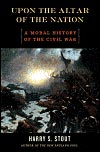 Upon the Altar of the Nation : A Moral History of the Civil War
By Harry S. Stout
Technorati tags: civil war, religion
Two historians tell why Christian thought went AWOL during the civil war.Here is a book review of two treatments of the role of theological thought in the years leading up and during the Civil War. Mark Noll is known to me, as I have read two of his books, but Harry Stout is not familiar to me. I look forward to reading both books, as they bring together two loves of mine: Theology and Civil War history.
Reviewed by Elesha Coffman | posted 08/17/2006 09:30 a.m.
"Historians have a formidable task when they try to explain why something happened. The task becomes even harder when they ask why something did not happen. Undaunted, Mark Noll and Harry Stout take this more difficult tack in their new books on the Civil War: Why did American Christians not think more deeply or act more ethically as the country faced bloody sectional conflict?
This type of history first requires demonstrating that the non-event could and should have occurred. Both authors identify moral voices crying in the wilderness—Abraham Lincoln (though he could be hard-hearted as well as humble), a few circumspect pastors and journalists, even Union Gen. George McClellan (Stout does not ascribe his infamous reticence to incompetence but to observance of the rules of limited war). Noll also brings in the never before studied perspectives of Europeans, Catholic and Protestant, who more clearly saw the flaws in American thinking about slavery, warfare, theology, and biblical interpretation. Stout cites the centuries-old Christian tradition of just-war theory. ..."
Having read a number of histories and biographies relating to the Civil War, it has become obvious to me that what I learned in school was not necessarily the way it was. But this review by Elesha Coffman indicates that there is much more to learn and understand about this tragic episode in our history.
The Civil War as a Theological Crisis (The Steven and Janice Brose Lectures in the Civil War Era)by Mark A. Noll
Upon the Altar of the Nation : A Moral History of the Civil WarBy Harry S. Stout
Technorati tags: civil war, religion
Wednesday, January 11, 2006
Preservationists lose battle over Wilson’s Creek
Preservationists lose battle over Wilson’s Creek:
The battles in Missouri and Arkansas are not as well-known as the ones east of the Mississippi, but they were significant nonetheless. The outcome of WIlson's Creek -- and several months later, Pea Ridge -- secured the western states for the Union, thus reducing the need for a large Union garrison in Missouri. It would be a tragedy if the rural countryside around Wilson's Creek National Battlefield were converted to housing developments. Our heritage should be given more respect.
Considering the location, this would be a bedroom community for Springfield, with a sizable increase in the tax base for Republic.
"REPUBLIC (AP) - A controversial housing development that abuts a Civil War battlefield has won approval from city officials, but a civil lawsuit could still stall the project...."
The battles in Missouri and Arkansas are not as well-known as the ones east of the Mississippi, but they were significant nonetheless. The outcome of WIlson's Creek -- and several months later, Pea Ridge -- secured the western states for the Union, thus reducing the need for a large Union garrison in Missouri. It would be a tragedy if the rural countryside around Wilson's Creek National Battlefield were converted to housing developments. Our heritage should be given more respect.
Considering the location, this would be a bedroom community for Springfield, with a sizable increase in the tax base for Republic.
Sunday, November 27, 2005
Return Home and the Civil War in Southwest Missouri
We have returned from a nice visit with my folks in Houston. As is our preferred schedule, we did about two-thirds of the driving the first day, and and coasted into Columbia the second day.
As we left our overnight stop in Joplin, Missouri, I glanced down at the instrument panel and noted that we were about at 1/8 tank. We got off the interstate at Carthage and filled up.
Carthage was the site of another Civil War battle on July 5, 1861 involving the Missouri State Guard under General Price Governor Claiborne Jackson, and Federal units under Colonel Franz Sigel who had been dispatched by General Nathaniel Lyon to cut off the retreat of State Guard forces following the battle at Boonville on June 17, 1861. After Boonville, the Missouri State Guard retreated quickly to the southwest and arrived ahead of Sigel's federal troops at a point north of Carthage. Sigel attacked, apparently unaware that he was seriously outnumbered, and the Missouri State Guard ran them through Carthage. Sigel and his men got out of the way, and headed back to Springfield where the rest of the Union forces in the area were gathered. Price, later joined by CSA General McCulloch, headed for northern Arkansas, which was his original objective. As battles go, the casualties were relatively light -- 44 Union, 74 Missouri State Guard -- but these forces would meet again in a month at Wilson's Creek as the Missouri State Guard attempted to position themselves to retake Springfield.
As mentioned before, Wilson's Creek, was a loss for the Union, but the Confederates were weakened. The Union troops withdrew from Springfield, moving closer to Rolla and the railhead, and the Missouri State Guard, for the moment, occupied Springfield. By the end of October, Price, having won several victories, including a major one at Lexington, Missouri, withdrew to Neosho at the approach of additional Union forces. Governor Claiborne Jackson and about 10% of the Missouri State Legislature (far from a quorum) met in Neosho on November 3, and passed an act of secession. By late December, Price had been forced into Arkansas along with the secessionist government (which never actually exercised any civil authority in Missouri) and settled in to prepare for further operations in Missouri, which would finally be thwarted at Pea Ridge in early March of 1862.
There were numerous battles and skirmishes in Missouri and the West, including some of the bloodiest of the early stages of the Civil War. Overall, the war's effects fell disproportionately on the South, and cost measured in civilian suffering was enormous.
As we enter Advent 2005, I want to present a familiar hymn of the season, but with two verses of the original poem that are not ordinarily sung. These verses, four and five in the original seven, lead into the verse beginning with "Then in despair I bowed my head." Henry Wadsworth Longfellow wrote these words in 1864 at a particularly dark time during the war:
I heard the bells on Christmas dayLongfellow wrote this as a poem rather than a hymn, but it has established itself as one of the best-loved Christmas carols. The complete words are on the Cyber Hymnal website, along with more than 5400 other hymns, many of which have historical information along with the words.
Their old familiar carols play,
And wild and sweet the words repeat
Of peace on earth, good will to men.
And thought how, as the day had come,
The belfries of all Christendom
Had rolled along the unbroken song
Of peace on earth, good will to men.
Till ringing, singing on its way
The world revolved from night to day,
A voice, a chime, a chant sublime
Of peace on earth, good will to men.
Then from each black, accursed mouth
The cannon thundered in the South,
And with the sound the carols drowned
Of peace on earth, good will to men.
It was as if an earthquake rent
The hearth-stones of a continent,
And made forlorn, the households born
Of peace on earth, good will to men.
And in despair I bowed my head
“There is no peace on earth,” I said,
“For hate is strong and mocks the song
Of peace on earth, good will to men.”
Then pealed the bells more loud and deep:
“God is not dead, nor doth He sleep;
The wrong shall fail, the right prevail
With peace on earth, good will to men.”
Monday, November 21, 2005
Pea Ridge -- March 6-8, 1862
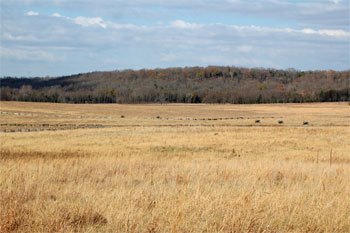 When we left Wilson's Creek we headed for Arkansas, following a route that was often identified as "Old Wire Road." This was a road running from St. Louis to Fort Smith Arkansas and was called "Telegraph Road" at the time of the Civil War.
In late 1861 President Lincoln appointed General Henry W. Halleck commander of the Department of the Missouri. Halleck took on the immediate task of eliminating General Price and his Missouri State Guard as a threat to Union control in Missouri, thus reducing the need for a large contingent of Federal forces, which were needed further to the east.
Brigadier General Samuel R. Curtis was appointed commander of the Army of the Southwest, and ordered to immediately engage the Confederate forces that remained in Missouri and northern Arkansas. The supply line for this winter offensive was a bit longer than comfortable, so he appointed a quartermaster, Captain Philip Sheridan, who would go on to gain recognition in later battles.
In the meantime, Jefferson Davis, President of the Confederate States of America, having become aware of the feud between Generals Price and McCulloch, appointed Major General Earl van Dorn commander of the Department of the Trans Mississippi. Generals Price and McCulloch were placed under van Dorn's command, and took their orders from van Dorn.
In the Fall of 1861, a meeting of about 10% of the Missouri Legislature had passed articles of seccession. As far as the Confederate government in Richmond, Virginia was concerned, Missouri was now a part of the Confederacy. The problem with this is that the meeting was held about as far away from Jefferson City as could be, without being in Arkansas; the action was not taken with anything near a quorum; and the "government" quickly became a government in exile as it moved to Arkansas.
General Curtis began his offensive with alacrity, and the remaining Confederate forces removed themselves to Arkansas, comprising an army of about 16,000. In
 early March of 1862 this force, having left its main body of supplies near Fayetteville, marched quickly north on Telegraph Road, intending to capture St. Louis and gain Missouri for the Confederacy.
General Curtis and his 10,500 soldiers of the Army of the Southwest were dug into positions south of Pea Ridge, expecting an assault from the south. Instead, van Dorn bypassed the Union positions and moved his forces around to the north.
Van Dorn's troops had endured a three-day march in wintry weather, and were in no condition to fight effectively. McCulloch's regiments separated from the main force, and were to recombine near Elkhorn tavern, along Telegraph Road. General
 McCulloch, wearing his customary black uniform and riding a black horse, decided to reconnoiter alone, as he was wont to do. He told his men he would be back shortly and to await his orders. Those orders never came, as McCulloch passed too close to the Union lines and was shot. General James McIntosh was also killed, and a major part of the Confederate Army of the West was without leadership.
Price's units were doing far better and were able to hold Elkhorn Tavern and Telegraph Road. The next day, General Curtis' artillery and troops retook the Elkhorn Tavern and Telegraph Road and drove the Confederate forces back. By this point, General van Dorn's decision to have each man under his command take only 40 rounds of ammunition forced him to order a withdrawal. The Confederacy would never again mount an effective campaign in Missouri, and the Union was able to send troops to the east of the Mississippi River.
As with Wilson's Creek, the decisions made by the commanders were key to which army retreated. Had General van Dorn not left his main supply train 3 days to the south, his superior numbers might well have determined the outcome. Had McCulloch and McIntosh not been killed the first day and had they left standing orders, their thousands of men might have joined the battle in time to turn the tide. The Confederates relied on dispatch riders to pass messages. An alarming number of these disappeared without a trace. The Union commander, General Curtis, on the other hand, was able to communicate effectively with his forces, as well as telegraph St. Louis and receive answers in a timely manner.
The Confederates withdrew deep into Arkansas, where they were near their supply lines and in friendly territory. It would be some time before the Union gained control of the lower Mississippi, Arkansas, and White rivers, thus controlling the supply routes into Arkansas, and gaining the ability to neutralize the Trans-Mississippi West as an obstacle to the restoration of the Union.
Sunday, November 20, 2005
Wilson's Creek -- August 10, 1861
The three of us left at 4:30 in the afternoon on Friday the 18th, and stopped for dinner at the Lake of the Ozarks. When I went to take my evening medications, I realized that my pills were still in the medicine cabinet. I called my physician, and he called in the prescriptions to the local Walmart where I filled them. Problem solved, except for my faulty memory. Chalk it up to the rush to get on the road...
We stayed the night at Buffalo, MO and were at Wilson's Creek by 8:30 AM Saturday morning.
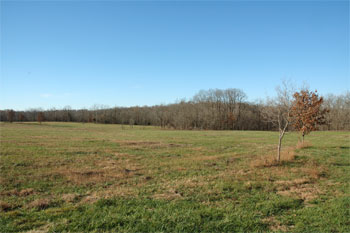
 The battlefield is in pretty much the same condition as it was 143 years ago, and the interpretive signs along the loop drive described the terrain and troop movements. The main difference was that the battle was fought in August of 1861, and we were there in late fall so our view was not as obstructed as it would have been for the 17,000 soldiers that fought there August 10.
General Nathaniel Lyon of the Federal forces was, by some accounts, reckless in his decision to mount a sneak attack on the Confederate positions. Other accounts view this as good strategy based on the intended outcome, which was to keep the secessionist forces off guard and unable to function effectively in the southwest corner of Missouri, where they had been driven.
General Price and his 5,000 Missouri State Guard troops had joined with Ben McCulloch's 4,500 Confederate regulars in July of 1861, and were trying to maintain a hold on the southwest corner of Missouri. The were camped along Wilson's Creek, and their location was known to the Federal forces, whose force of about 6,000 men was garrisoned in Springfield. During July and early August the combined forces of Price and McCulloch totaled more than 12,000
The Southern commanders had planned a suprise attack on the Federals on August 9th, but called it off due to rain. Unlike the Union troops, with their leather cartridge boxes, the paper cartridges used by the Southern troops were carried in pockets or otherwise exposed to the elements. Inexplicably, the Confederate sentinels were not posted that night and there was no one to observe the Union movements that evening and early the next morning.
General Lyon decided to mount a surprise attack the morning of August 10, and in another fateful event, the two Southern generals were in a location that provided an "accoustic shadow". That the Confederate positions were under attack was not believed at first, wasting valuable time.
When Price and McCulloch were able to marshal their troops and give orders, the tide rapidly turned against the Union forces, and they retreated to Springfield, having inflicted about as many casualties on the Confederates as were inflicted upon them.
The Union supply line relied on the railroad delivering materiel to Rolla, the end of the railway heading toward Springfield. Well-maintained dirt and gravel roads were used to deliver the supplies to Springfield where the quartermaster allocated them to Union forces in the area.
The Confederates lived off the land, and were not able to stay in one place, since they had no supply lines through Missouri (The Union held the rivers, roads and railways). The Southern forces did not endear themselves to the local poplulace, which were not particularly sympathetic to the Southern cause in the first place, with their "requisitioning" of food, horses, and housing. The Union, for the most part, gave accounting for what they requisitioned. The war in southwest Missouri, as wars usually do, took a great economic toll on the local citizens, who were in the process of harvest.
All in all, the battle was a Southern victory, but in another fateful turn of events, Price and McCullough went their separate ways after a dispute. The regular army McCulloch considered Price nothing more than a political general leading a state militia (partially true, but a bit unfair, considering Price's record). Price had issues with General McCullough's plans and was unwilling to commit his troops to another's command.
Subsequently, when Price and his command were subsumed into the Confederacy, both Price and McCulloch were placed under another general's command, and they would serve together again seven months later at the Battle of Pea Ridge.
We stayed the night at Buffalo, MO and were at Wilson's Creek by 8:30 AM Saturday morning.
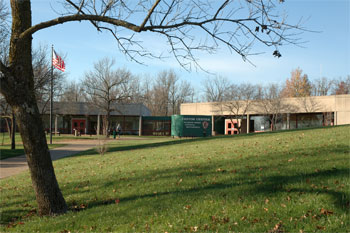 The battlefield is in pretty much the same condition as it was 143 years ago, and the interpretive signs along the loop drive described the terrain and troop movements. The main difference was that the battle was fought in August of 1861, and we were there in late fall so our view was not as obstructed as it would have been for the 17,000 soldiers that fought there August 10.
General Nathaniel Lyon of the Federal forces was, by some accounts, reckless in his decision to mount a sneak attack on the Confederate positions. Other accounts view this as good
 strategy based on the intended outcome, which was to keep the secessionist forces off guard and unable to function effectively in the southwest corner of Missouri, where they had been driven.
General Price and his 5,000 Missouri State Guard troops had joined with Ben McCulloch's 4,500 Confederate regulars in July of 1861, and were trying to maintain a hold on the southwest corner of Missouri. The were camped along Wilson's Creek, and their location was known to the Federal forces, whose force of about 6,000 men was garrisoned in Springfield. During July and early August the combined forces of Price and McCulloch totaled more than 12,000
The Southern commanders had planned a suprise attack on the Federals on August 9th, but called it off due to rain. Unlike the Union troops, with their leather cartridge
 boxes, the paper cartridges used by the Southern troops were carried in pockets or otherwise exposed to the elements. Inexplicably, the Confederate sentinels were not posted that night and there was no one to observe the Union movements that evening and early the next morning.
General Lyon decided to mount a surprise attack the morning of August 10, and in another fateful event, the two Southern generals were in a location that provided an "accoustic shadow". That the Confederate positions were under attack was not believed at first, wasting valuable time.
When Price and McCulloch were able to marshal their troops and give orders, the tide rapidly turned against the Union forces, and they retreated to Springfield, having inflicted about as many casualties on the Confederates as were inflicted upon them.
The Union supply line relied on the railroad delivering materiel to Rolla, the end of the railway heading toward Springfield. Well-maintained dirt and gravel roads were
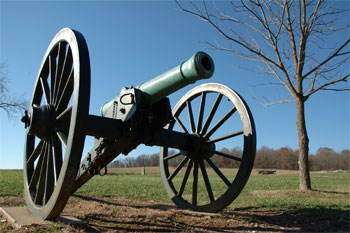 used to deliver the supplies to Springfield where the quartermaster allocated them to Union forces in the area.
The Confederates lived off the land, and were not able to stay in one place, since they had no supply lines through Missouri (The Union held the rivers, roads and railways). The Southern forces did not endear themselves to the local poplulace, which were not particularly sympathetic to the Southern cause in the first place, with their "requisitioning" of food, horses, and housing. The Union, for the most part, gave accounting for what they requisitioned. The war in southwest Missouri, as wars usually do, took a great economic toll on the local citizens, who were in the process of harvest.
All in all, the battle was a Southern victory, but in another fateful turn of events, Price and McCullough went their separate ways after a dispute. The regular army
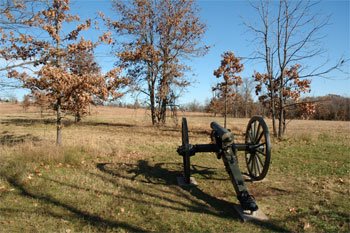 McCulloch considered Price nothing more than a political general leading a state militia (partially true, but a bit unfair, considering Price's record). Price had issues with General McCullough's plans and was unwilling to commit his troops to another's command.
Subsequently, when Price and his command were subsumed into the Confederacy, both Price and McCulloch were placed under another general's command, and they would serve together again seven months later at the Battle of Pea Ridge.
Friday, November 18, 2005
The Civil War in the West
This afternoon, when my son gets home from school, we will start heading south through Missouri and spend the night near Springfield. Saturday morning we will tour Wilson's Creek Battlefield, which was the second major battle of the Civil War. By all objective standards it was a loss for the Union, yet it was instrumental in preventing the Confederate-leaning Missouri State Guard under the command of General Sterling Price from taking enough key points to deliver Missouri into the Confederacy.
General Nathaniel Lyon, who was a captain at the outset of the war, mounted a suprise attack on August 10th 1861 with 5,400 men -- less than one-half the 12,000 men at General Price's disposal. Both sides lost over 1200 men apiece (including General Lyon), and the Union forces performed a rapid retreat, but the damage was done. Price and another commander chose to split their forces and the state of Missouri remained in the Union.
On March 6-8, 1862, about 80 miles away, another major battle involving over 26,000 combatants occurred at Pea Ridge, Arkansas. This was a clear Union victory, and pretty much ended the Confederacy's aspirations in the West.
One particularly interesting aspect of all this are the supply lines -- In Missouri, the Union controlled the big rivers -- the Missouri, Osage, and it's bank of the Mississippi. The railroad heading southwest stopped at Rolla (I-44 travels this corridor down toward Springfield today). The supply lines for the Union in Springfield were pretty long, but manageable. The supply lines toward Little Rock were several hundred miles long, thus the Union army spent a lot of time camping rather than fighting.
When one thinks of the key battles of the Civil War, the ones in the east come to mind, yet Missouri was the site of many bloody battles.
We will continue heading south toward Houston, TX after our visit to Pea Ridge. My boy will miss two days of school, but his language arts teacher will expect a journal of his visits to the battlefields, and other experiences along the way. Maybe he'll be interested in blogging...
General Nathaniel Lyon, who was a captain at the outset of the war, mounted a suprise attack on August 10th 1861 with 5,400 men -- less than one-half the 12,000 men at General Price's disposal. Both sides lost over 1200 men apiece (including General Lyon), and the Union forces performed a rapid retreat, but the damage was done. Price and another commander chose to split their forces and the state of Missouri remained in the Union.
On March 6-8, 1862, about 80 miles away, another major battle involving over 26,000 combatants occurred at Pea Ridge, Arkansas. This was a clear Union victory, and pretty much ended the Confederacy's aspirations in the West.
One particularly interesting aspect of all this are the supply lines -- In Missouri, the Union controlled the big rivers -- the Missouri, Osage, and it's bank of the Mississippi. The railroad heading southwest stopped at Rolla (I-44 travels this corridor down toward Springfield today). The supply lines for the Union in Springfield were pretty long, but manageable. The supply lines toward Little Rock were several hundred miles long, thus the Union army spent a lot of time camping rather than fighting.
When one thinks of the key battles of the Civil War, the ones in the east come to mind, yet Missouri was the site of many bloody battles.
We will continue heading south toward Houston, TX after our visit to Pea Ridge. My boy will miss two days of school, but his language arts teacher will expect a journal of his visits to the battlefields, and other experiences along the way. Maybe he'll be interested in blogging...
Subscribe to:
Posts (Atom)