Wednesday, August 30, 2006

Book Review: The Language of God (Part 2)

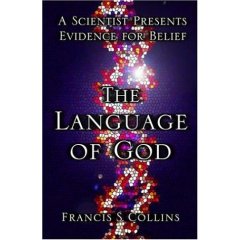
The Language of God - A Scientist Presents Evidence for Belief
Francis S. Collins
New York: Free Press, a division of Simon and Schuster
2006

In Chapters 6-11 (Faith in Science, faith in God), Collins presents several options for how scientists can choose to engage spiritual matters:
  • Chapter 6 -- Genesis, Galileo, and Darwin
  • Chapter 7 -- Option 1: Atheism and Agnosticism (When Science Trumps Faith)
  • Chapter 8 -- Option 2: Creationism (When Faith Trumps Science)
  • Chapter 9 -- Option 3: Intelligent Design (When Science Needs Divine Help)
  • Chapter 10 -- Option 4: BioLogos (Science and Faith in Harmony)
  • Chapter 11 -- Truth Seekers
Chapter 6: Collins takes us on a short tour of the history of the conflict. Until people had the tools to observe and measure the world around them, it never occurred to anyone that Genesis could be anything but a literal account of the Universe and its creation. When such observers as Copernicus and Galileo began turning their intellect and primitive telescopes toward the heavens, they began to see patterns that could only be explained by a system of planets, moons, and stars that did not revolve around the earth, but moved in diferent ways, depending on their location and proximity to other objects. When the heliocentric model was proposed four our solar system Galileo ran into severe difficulties when he embraced it. He was forced to recant and spent the rest of his life under what amounted to house arrest. It took the Catholic Church until 1992 to finally and officially acknowledge that Galileo was innocent of heresy (althought to be fair, when the heliocentric model became obvious to even casual observers, the Church did not object during the intervening 350 years between Galileo's conviction and exoneration).

When Darwin published The Origin of Species in 1859, based on observations he made some 20 years previously, he also encountered opposition, (though not an Inquisition). He also encountered praise and admiration for coming up with what appeared to be a sound model for explaining how populations change genetically over time. As with astronomy, the theory proposed by Darwin ran counter to a particular interpretation of Scripture, and that controversy continues to this day.

In this section Collins quotes Augustine, who wrote 1600 years ago in a commentary on Genesis:
"...Now it is a disgraceful and dangerous thing for an infidel to hear a Christian. presumably giving the meaning of Holy Scripture, talking nonsense on these topics [motion and orbit of the stars, eclipses, biology, geology, etc.]; and we should take all means to prevent such an embarrassing situation, in which people show a vast ignorance in a Christian and laugh it to scorn. ..."
I wonder just what people were saying about planetary motion, eclipses, and biology that prompted Augustin to say such things....

Chapter 7: Collins discusses the problems with both points of view, and the inconsistencies each might present for a scientist. The term "agnostic" was coined by Thomas Henry Huxley ("Darwin's Bulldog") as a way to express the fact that he simply didn't know whether there was or was not a God. In a humorous anecdote involving Darwin and two atheists at a dinner party, Darwin expressed a preference for "agnostic" over "atheist" to describe his position. One of his guests replied "agnostic was but atheist writ respectable, and atheist was only agnostic writ agressive."

Certainly there is a continuum of degree within and between the two categories. A significant amount of space in chapter 7 is given to Richard Dawkins, representing the extreme of atheism. Dawkin's oft-quoted statement that "...faith is one of the worlds's great evils, comparable to the smallpox virus but harder to eradicate" is rebutted skillfully and without rancor.

Collins then turns to what he terms an "unlikely source", the late Stephen J. Gould, to demonstrate clearly the fundamental incompatibility between the dogmatic atheism of Dawkins and the proper use of science. Gould writes
"...To say it for all my colleagues and for the umpteenth millionth time: Science simply cannot by its legitimate methods adjudicate the issue of God's possible superintendence of nature. ..."
Gould continues with a list of evolutionary biologists, some of whom were his colleagues: Charles Darwin, George Gaylord Simpson, both agnostics; and Asa Gray, Charles Wolcott, and Theodosius Dobzhansky, all three devout Christians. This extended quote from Gould ends with this:
"Either half my colleagues are enormously stupid, or the science of Darwinism is fully compatible with conventional religious beliefs -- and equally compatible with atheism."
Having read a significant portion of Gould's popular articles and books, and a smaller, but not insignificant number of his scientific articles, I am not suprised that Gould held this belief. He was clearly an agnostic, but first and foremost he was a scientist who recognized that equally talented men and women could come to different conclusions than he as far as the spiritual realm was concerned.

Collins concludes chapter 7 with the statement that if science and its methods provide an accurate description of the physical and biological world, and there is truly a God, then they cannot contradict each other. Yet, these two "versions of truth" are at war, and mutual misunderstanding feeds the conflict.

Well, this second part of my book review has ended up being far longer than I intended, but I thought it important to cover Collins' basis for making his conclusions in the subsequent chapters.

Next: Creationism, Intelligent Design, and BioLogos (Collins' framework for allowing science and faith to live together in harmony)

Tuesday, August 29, 2006

Book Review: The Language of God (Part 1)


The Language of God - A Scientist Presents Evidence for Belief
Francis S. Collins
New York: Free Press, a division of Simon and Schuster
2006


Francis Collins is a medical geneticist who has spent his professional life trying to understand what goes wrong in certain diseases. His early research into the "typo" in the genetic code that leads to cystic fibrosis led to his being invited to lead one of the teams that engaged in a "race" to decode the human genetic code.

He is also a Christian whose path took him through agnosticism, through atheism, and finally faith after he was challenged to read Mere Christianity by C.S. Lewis. He found himself questioning the things he thought he knew.

The Language of Life in divided into three parts:
  • Part 1: Chapters 1-2 -- The Chasm Between Science and Faith
  • Part 2: Chapters 3-5 -- The Great Questions of Human Existence
  • Part 3: Chapters 6-11 -- Faith in Science, Faith in God
An appendix discusses issues of medical bioethics and the moral practice of science.

The first part discusses his personal journey to faith with many personal reflections on what went through his mind as he grew up. His parents were quite instrumental in laying the groundwork for his educational and social development. Much of his growing years were spent involved in organic farming, music, and summer theater. Collins chose a different path than his somewhat counter-cultural parents as far as faith is concerned, but nonetheless he dedicated his book to his parents.

In the second part, Dr. Collins discusses the science that is involved, and why it is necessary to know and understand the genetic code in order to understand how genetic disease can be treated. In addition he tells a fascinating story of two competing groups who were in a race to decode the human genome, one publically funded and the other privately funded. One group was dedicated to rapid disemination of the results, and the other was interested in a return on the investment of the private parties who underwrote the research.

As both groups converged on the goal of decoding the human genome, Francis Collins had a nightime meeting with Craig Venter, his counterpart on the privately-funded side, that was arranged by a mutual friend. The meeting took place in the basement of the friend's house over pizza and beer. It almost seems "cloak-and-dagger", and in a way it was. An inquisitive reporter could have blown the whole thing out of the water and eliminated any hope of cooperation between the two groups. As it turned out, the two team leaders appeared jointly at a White House Press Conference on June 26, 2000 to announce the completion of the task.

Francis Collins is a quirky individual, and often brings a guitar to meetings. It is hard to imagine a room full of scientists singing along to a ballad about genetic research written to familiar music, but it seems to happen on a regular basis where Collins is involved. Having personally been involved with science for many years myself, I think we could use more scientists who actually have a life....

In the next two installments of this three part review, I will focus in on Collins' assessment of different ways one can bring their worldview to bear on science and religion, and the pitfalls involved with most of them. His groundwork in the nature of science that he lays in the first two parts will serve the reader well as he discusses atheism/agnosticim, creationism, and intelligent design, as well as his own proposal for a framework for understanding the relationship of science and faith.

Tommorow: Chapters 6-10 on the often uneasy relationship between science and faith

Monday, August 28, 2006

Outlook: No need of you?

No need of you?:
Presbyterian Outlook (free registration required)
Jack Haberer, Outlook editor-in-chief
08/28/2006

"Denominational loyalty. Virtue? Or vice?

Like national patriotism, denominational loyalty can engender sacrificial service and arm-in-arm teamwork.

Like national patriotism, denominational loyalty can blind us to our own ignorance, to our glaring mistakes, and especially, to the value and needs of those outside our circle.

On the other hand, denominational disaffection can launch outside-the-box missional creativity. And it can unleash a scorched-earth destruction of vital ministries and of tenderfoot believers. ..."
Jack Haberer is not going to resonate with all Presbyterians with this editorial, but he certainly deserves to be heard. His call to a different kind of loyalty cuts across the entire spectrum of our denomination.

What kind of "different loyalty"? The loyalty that comes from Jesus who said “A new command I give you: Love one another. As I have loved you, so you must love one another. By this all men will know that you are my disciples, if you love one another.” (John 13:34-35 NIV)

How we interact with, speak of, and treat other Christians matters. The sixth of the Great Ends of the Church (Book of Order G-1.0200) is "The Exhibition of the Kingdom of Heaven to the World." What does the Kingdom of Heaven look like to someone observing the internecine bickering, sniping and unpleasantness emanating from all sides in our denomination?

Jack Haberer is asking the right questions here, and I hope we all can take time to reflect on these questions. We all have our different levels of concern about our denomination, and will disagree on what constitutes a crisis, but our failure to follow Jesus' commandment to love one another is a scandal. We can do better.

Technorati tags: ,

Friday, August 25, 2006

CNN.com - Pluto gets the boot - Aug 24, 2006

CNN.com - Pluto gets the boot - Aug 24, 2006:
"PRAGUE, Czech Republic (AP) -- Leading astronomers declared Thursday that Pluto is no longer a planet under historic new guidelines that downsize the solar system from nine planets to eight. ..."
When Pluto was discovered in 1930 its planetary status was a bit borderline, but it was added anyway to the eight previously known planets of our Solar System.

Now those of us who memorized the planets as school children need to learn to stop at Neptune.

Gustav Holst composed his orchestral suite, The Planets, in 1918, so musical history will not need to be revised.

But what IS a planet? According to this CNN article, there has been no clear definition of planets since they were first discovered.

The International Astronomical Union, meeting in Prague, released their definition of a planet on August 24, 2006:
(1) A "planet"1 is a celestial body that (a) is in orbit around the Sun, (b) has sufficient mass for its self-gravity to overcome rigid body forces so that it assumes a hydrostatic equilibrium (nearly round) shape, and (c) has cleared the neighbourhood around its orbit.

(2) A "dwarf planet" is a celestial body that (a) is in orbit around the Sun, (b) has sufficient mass for its self-gravity to overcome rigid body forces so that it assumes a hydrostatic equilibrium (nearly round) shape2 , (c) has not cleared the neighbourhood around its orbit, and (d) is not a satellite.

(3) All other objects3 except satellites orbiting the Sun shall be referred to collectively as "Small Solar-System Bodies".


1The eight planets are: Mercury, Venus, Earth, Mars, Jupiter, Saturn, Uranus, and Neptune.
2An IAU process will be established to assign borderline objects into either dwarf planet and other categories.
3These currently include most of the Solar System asteroids, most Trans-Neptunian Objects (TNOs), comets, and other small bodies.
Pluto (whose orbit intersects with Neptune's) met the first two criteria for planets, but inasmuch as it is not the only spherical object in the Kuiper Belt (or the region beyond Neptune), nor is it even the largest, it failed to meet the third criterion. The object UB313 ("Xena") is larger.

Owen Gingerich (Harvard University) was chair of the Planet Definition Committee. Gingerich is well-known in Christian circles and a quick Google search turned up a piece entitled Is the Cosmos All There Is? in which he discusses ways of looking at reality.

Technorati tags: , ,

Thursday, August 24, 2006

Quotidian Grace: News From New Covenant Presbytery

Quotidian Grace: News From New Covenant Presbytery:
"... In light of the events surrounding the recent vote by the session of Kirk of the Hills Church in Tulsa to withdraw from the PCUSA, it was very important to make it clear that our process is not secret and that it emphasizes a pastoral rather than a litigious approach. Friends, the PCUSA will not be preserved through litigation. We must find a more excellent way, and pronto.

What if congregations and pastors considering leaving the PCUSA could have open and honest conversations with representatives of presbytery about their concerns without worrying that they were opening themselves to pre-emptive legal action from the denomination? What if they knew that the presbytery was willing to work with them to resolve their concerns even if the result was their withdrawal from the denomination? What if they knew that they could discuss the property implications with presbytery in advance and negotiate that issue without fear of legal reprisal? ..."

Quotidian Grace (aka Jody Harrington) was elected moderator of the Presbytery of New Covenant in Houston TX for 2008. Judging from her blog postings and the concern they show for not only the institution of the Presbyterian Church (USA) but equally for meeting controversy with pastoral concern, love, and mutual forbearance, I suspect that Houston Presbyterians are the better for it.

My parents live in Houston, apparently not far from QG's church, although they are members of another PC(USA) congregation. Maybe my wife and I will get the opportunity to meet her in person over Thanksgiving week.

The quote above relates to one of the actions of New Covenant that proposes to set up an open process for congregations and the presbytery to discuss issues of major concern without the threat of preemptive legal action through the courts or the forming of an administrative commission to rule a congregation that has expressed frustration with the way things are going. Recent events in Iowa and Oklahoma, not to mention a document from a legal counsel in the Stated Clerk's office that outlines preemptive legal action that can be taken against congregations that express a desire to leave the PC(USA), are troubling.

It is good to hear that this presbytery is trying to ameliorate the tension, mistrust, and (in my opinion) outright unchristian behavior that is being demonstrated by both sides in this difficult issue.

I have had occasion to see how such disputes play out in two presbyteries. In one case in the late 1970s in Denver, a fairly large congregation voted overwhelmingly to affiliate with another reformed denomination. Locks were changed, armed guards were posted, and the congregation began meeting in temporary quarters until they could acquire new property. They did not sue because they felt in was unscriptural. In other words, they "peacably withdrew". In another instance in another presbytery, after much discussion, prayer, and deliberation, the presbytery sold their interest in the property and dismissed the congregation with their blessing and in friendship.

Both sides have to choose to work in Christian fellowship and mutual trust for this to work. I think it is safe to say that not all disaffected congregations are willing to do that, nor are all presbyteries inclined toward pastoral solutions to such problems, but with with God's grace and our willingness to engage each other, we ought to be able to negotiate these difficult times. As QG put it, "We hope that is what our process can achieve, and that it will build trust and thereby keep congregations from leaving or allow for a regretful parting of the ways without adding more rancor and angst".

In another action the Presbytery of New Covenant voted by a 2:1 margin to remind ordaining bodies within the Presbytery that where the Book of Order uses the words "shall", "is or are to be", "required", or words and phrases with equivalent meaning, that they are not subject to "scrupling", and shall be complied with.

Technorati tags: ,

Tuesday, August 22, 2006

Class Warfare - Christianity Today Magazine

Class Warfare - Christianity Today Magazine:
(free registration required to read the full article)
by J. Edward Mendez, RNS, with reporting by Jason Bailey

"A Washington-area megachurch filed a federal lawsuit July 3 challenging a government ruling that it was improperly holding seminary-level classes on church grounds.

The nondenominational McLean Bible Church, which draws about 9,500 worshipers weekly to its services in Fairfax County, Virginia, partnered with Capitol Bible Seminary in 2001 to offer Bible study and religious ministry classes. The church did not issue academic credit or confer degrees. But students were allowed to take classes at the church for credit toward a master's degree in biblical studies and theology from the seminary. ..."
A couple observations:

9500 worshippers weekly? A former pastor described to me his reasons for leaving a large congregation in Florida to be pastor of a small congregation in Colorado. As he described the church buildings and the numbers of people at the services he said "That's not pastoring; that's ranching!"

They'd been doing this for three years? Why react now? Especially when Fairfax County issued a special use permit in 1999 with the proviso that "church facilities shall only be made available for use by groups or activities which are sponsored by the church and are consistent with its ministry objectives."

These courses may not be typical of the offerings of the average congregation, but the content surely is in line with teaching the faith. The reasoning put forth by the planning and zoning people is a little troubling.

The congregation in which I worship is in a university town, and among other disciplines represented in the membership is theology. If a university professor teaches a course (and they do from time to time), does it change the character of the Christian Education offerings from being a simple Sunday School to being an institution of higher learning?

Links from the Christianity Today Article:
Technorati tags: , ,

Sunday, August 20, 2006

PGF considers challenges of Western mission efforts, next steps for organization

PGF considers challenges of Western mission efforts, next steps for organization:
Presbyterian Outlook, free registration

by
Leslie Scanlon, Outlook national reporter
"ATLANTA – They’re good-hearted Presbyterians – serious about their faith, people who want to show God’s love to a suffering world. But it’s not as easy as just getting on a plane with a suitcase and a pocket stuffed with dollars.

In a religiously diverse world, in which Americans often enjoy prosperity and peace which others do not share, working in partnership with others can be a complicated thing. And those at the Presbyterian Global Fellowship http://69.15.106.21/ meeting August 17-19 – a mostly white, evangelical crowd – were challenged to temper their energy for mission with some hard thinking about realities that are not always comfortable to face.

Lucas de Paiva Pina, a Brazilian who is working with immigrant fellowships in Georgia, looked out across the room and said: “We need to put more color here – yellow, black, red, all of them.”

The Presbyterian Church (U.S.A.) has pledged to become 20 percent people of color by 2010, but still is more than 92 percent white.

Americans who want to work with the global church need “to change the attitude of we-and-they,” Pina said. “We need to understand that in Christ, we are brothers and sisters. We are a family with different languages, different colors, different cultures, but we are from the same family, saved by the same Savior.”
..."
There seems to have been a lot of frank talk at the recent meeting of the Presbyterian Global Fellowship. While this new organization is shaping up to be a strong advocate for mission in the world, it is not necessarily of the opinion that all is well with how we have historically carried out mission. I can't say I am 100% in agreement with everything I have read about the proceedings (especially Roberta Hestenes' comments on mission trips), I cannot fault the introspection that is going on here. It is healthy, and is directed toward moving forward. And Hestenes' comments are worth considering in that they urge us not to forget long-term missionaries in our zeal to organize short-term mission trips.

The Presbyterian Global Fellowship, according to its FAQ, is not trying to drive a wedge between Presbyterians, nor is it trying to erect a new government within the PC(USA) -- rather it is attempting to move forward -- away -- from the sexuality issues that are preventing us from being the Church.

With all the talk of schism being fed by internal and external influences, this represents a breath of fresh air for those who love our denomination and want to see its mission go forward.

The following web sites have good coverage:

Presbyterian Global Fellowship
Presbyweb (a 30 day trial period is available)
The Presbyterian Outlook (free registration required to read the full articles)
Russell Smith -- The Eagle and Child
Larry Wood -- A PCUSA Pastor's Blog
Ed Brenigar -- The Presbyterian Polis

Technorati tags: , , ,

Saturday, August 19, 2006

deseretnews.com | Gospel truth or legends?

deseretnews.com | Gospel truth or legends?:

Alternate link

By MARY A. JACOBS / Special Contributor to The Dallas Morning News
"Madalyn Murray O'Hair never petitioned the Federal Communications Commission to get religious broadcasting off the air. James Dobson never launched a petition drive to stop her. ...

...Many of the legends seem to appeal to conservative and evangelical Christians and are widely circulated by e-mail and on blogs they read.

But some within the evangelical community have taken on myth-busting as a ministry. Web sites such as TruthMiners.com and Answers.org expose hoaxes and urge Christians not to pass on unsubstantiated rumors. ..."
Mary Jacobs, writing in the Dallas Morning News, shows how email, taken uncritically, can spread falise information quickly and effectively. Such web sites as TruthOrFiction.com, Snopes.com, and the two linked in the quote above are useful resources in checking out email rumors.

This article makes the point that Christian credibility us undermined by repeating unsubstantiated rumors, especially when the internet which brought such rumors to you is also the means by which you can obtain authoritative information.

This becomes even more urgent in election years when rumors, half-truths, and outright lies pervade the internet. Reading web sites from across the political and religious spectrum has demonstrated to me that truth and accuracy becomes inconvenient when there are elections to be won, or denominations to be controlled.

Bloggers, who are by-and-large self-policed, have a part to play in all this whether it be for good or evil (apologies to J.R.R. Tolkien). Personally, I am happy to be involved in the Presbyterian Bloggers, a loose organization of 93 (as of this morning) bloggers "whose blogging is decent and in order." I don't agree with all the views I see there, but the discourse is generally civil, and many virtual friendships have sprung up among members of this group. See the Presbyterian Bloggers webring links at the top of the sidebar for entry into the decent and orderly side of blogging.

Technorati tags: , ,

Thursday, August 17, 2006

Mine Eyes Have Seen the Gory - Christianity Today Magazine

Mine Eyes Have Seen the Gory - Christianity Today Magazine:
Two historians tell why Christian thought went AWOL during the civil war.
Reviewed by Elesha Coffman | posted 08/17/2006 09:30 a.m.

"Historians have a formidable task when they try to explain why something happened. The task becomes even harder when they ask why something did not happen. Undaunted, Mark Noll and Harry Stout take this more difficult tack in their new books on the Civil War: Why did American Christians not think more deeply or act more ethically as the country faced bloody sectional conflict?

This type of history first requires demonstrating that the non-event could and should have occurred. Both authors identify moral voices crying in the wilderness—Abraham Lincoln (though he could be hard-hearted as well as humble), a few circumspect pastors and journalists, even Union Gen. George McClellan (Stout does not ascribe his infamous reticence to incompetence but to observance of the rules of limited war). Noll also brings in the never before studied perspectives of Europeans, Catholic and Protestant, who more clearly saw the flaws in American thinking about slavery, warfare, theology, and biblical interpretation. Stout cites the centuries-old Christian tradition of just-war theory. ..."
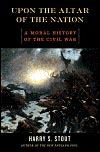
Here is a book review of two treatments of the role of theological thought in the years leading up and during the Civil War. Mark Noll is known to me, as I have read two of his books, but Harry Stout is not familiar to me. I look forward to reading both books, as they bring together two loves of mine: Theology and Civil War history.

Having read a number of histories and biographies relating to the Civil War, it has become obvious to me that what I learned in school was not necessarily the way it was. But this review by Elesha Coffman indicates that there is much more to learn and understand about this tragic episode in our history.


The Civil War as a Theological Crisis (The Steven and Janice Brose Lectures in the Civil War Era)
by Mark A. Noll


Upon the Altar of the Nation : A Moral History of the Civil War
By Harry S. Stout


Technorati tags: ,

Birds and Mammals From Teton-Yellowstone

Osprey in flight over Excelsior Geyser Crater, YNP

I was taking pictures with my 18-70mm lens, and an eagle and osprey had a little territory dispute over the Excelsior Geyser Crater. By the time I got my 70-300 lens mounted, they both had taken off. I left the longer lens mounted and about 20 minutes later the osprey returned for a few circles around the geyser basin.

Osprey at Cottonwood Creek, GTNP

Osprey are fish eaters, and far better at catching them than I. Typically they will rest with a good view of a body of water and wait until something interesting happens. In this case, it must have been a boring morning with two phographers circling the dead tree looking for good angles.

Pika hiding behind a Thimbleberry leaf, Cascade Canyon Trail, GTNP

We saw a leaf running around a talus slope on the trail. It was a pika working on laying in its supply of hay for the winter.


Yellow-bellied Marmot on Cascade Canyon Trail, GTNP

I lived in Colorado for many years, and thus was quite familiar with marmots long before I ever saw a woodchuck (although from an early age I knew how much wood a woodchuck could chuck).

Bald Eagle overlooking Jenny Lake, GTNP

As we ended our Cascade Canyon hike and the ferry had started its way back across Jenny Lake, the pilot said that there was an eagle at the top of a tree. I twisted around, zoomed out to 300mm, and grabbed two quck shots just as the pilot stepped in the gas. This one was the sharpest of the two images. I wish the pilot had given us a little more warning, but at least I had the proper lens on at the time.


Two bison having a tender moment along the Yellowstone river

About 50 or so bison were on either side of the road from Canyon village to Yellowstone Lake, and a park ranger was trying to shoo drivers along, as there was a bit of a back up. When the ranger got a little further along he saw that the main problem was there were bison sauntering back and forth along the road. So he started herding them with his vehicle. Yee-haaaa!


Bull Moose at Oxbow Bend, GTNP

As we left the park Saturday morning (8/12) for our long drive back we saw a large number of cars parked at the turnout at Oxbow Bend on the Snake River. I look to the right, saw the rack on this beast, and parked. I grabbed the camera and Liam and we circled around to where some other photographers were taking pictures. After Susan secured the car, she came down as well.

This moose, who is as high at his shoulder as I am tall, was browsing the cottonwoods and aspens for his breakfast, and occasionally providing a good pose. Between my son and I we took nearly 50 images. Ah, the joys of large memory cards... The collar intrudes a bit on the scene, but I suppose it is there for a good reason.

Wednesday, August 16, 2006

Vacationing in the Tetons

Earlier I indicated that we would not even try for the Jenny Lake campground, as it is the most popular of the sites. Well, we stayed Saturday night (8/5) just outside the Grand Teton National Park in a Forest Service campground, got up early Sunday (8/6), packed, and hit the Moran Junction entrance about 6:30 AM.

The view from the tent

I inquired of the ranger as to the chances of getting a site at Jenny Lake, and he said it was worth a try, so we tried. We got to the campground just before 7:oo AM and learned that there were three sites known to be available, and possibly a couple more. We took the first one we saw, and that was our home for the next 6 nights. Jenny Lake CG is tents only while the Lizard Creek CG has a vehicle length limit of 30 feet. Being an inveterate tent camper, the choice was easy.

The view from the bathroom door

As we drove in we saw a young man carrying a guitar accompanied by two young women. It appeared that they were setting up for a church service, so after we set up the tents, we went over to the amphitheatre for Sunday services.

Mount Teewinot from the Amphitheater at dawn

These volunteers operate under the auspices of A Christian Ministry in the National Parks, and work in one of the concessions in the park. This organization is non-denominational and is supported by 40 denominations. It was a good and meaningful service, and one could not ask for a more beautiful sanctuary in which to worship.

Oxbow Bend on the Snake River at dusk

I remember the Tetons from 30 or more years ago when the best view I got was the tip of Grand Teton poking up above the clouds. This time there was not a day when the Teton Range was not clearly visible.

It's time to get to work, so I wait until later to post the mammal and bird images. Maybe I can talk Susan into posting some of her flower images.

The Hancocks with Mount Moran behind them

Tuesday, August 15, 2006

Fun with Infrared Photography

One of the nice features of digital photography is that the sensor is capable of infrared imaging. Much of it is filtered out by the sensor, but there is enough sensitivity that, with the proper filter, you can take some pretty stunning images.

For these, I used a Nikon D-70 with 18-70mm zoom lense with a Hoya R72 filter. This filter passes only wavelengths above 720 nanometers, which is at the far edge of visibility to human eyes. A tripod was necessary, since the exposures can run up to 5 or more seconds, depending on your aperture. Since infrared focuses at a different point than the visible spectrum, I shot at f/22 to increase depth of field. I processed the raw image with Nikon Capture Editor, saved it as a jpeg, and edited it in Photoshop CS, where I desaturated the remaining red coloration, then resaved it as a smaller jpeg for uploading to the blog.

Blue skies generally render as quite dark, with clouds tending toward their natural color. Deciduous leaves are nearly white and pine needles are lighter than normal, but not as white as, say, aspen leaves. Water tends to be fairly dark.

For those who remember B&W photography and filters, using a red filter would achieve a similar effect with darkening the sky, but leaves and pine needles would be darkened as well. Infrared imaging operates differently and is used in aerial photography to study patterns of disease and stress in forests and cropland.

Mount Moran, north of the Jenny Lake Junction

Mount Moran, visible spectrum


Mount Teewinot, from the east shore of Jenny Lake

Mount Teewinot, visible spectrum

Monday, August 14, 2006

Book Tag or Better Late than Never

Mike Kruse tagged me while I was out of town, so here is my belated response:
  1. One book that changed your life: Knowing God by J.I. Packer
  2. One book that you’ve read more than once: The Source by James A. Michener.
  3. One book you’d want on a desert island: The Chronicles of Narnia by C.S. Lewis. Yes, I know it is more than one book, but I do have a one-volume edition...
  4. One book that made you laugh: The Lord of the Rings by J.R.R. Tolkien
  5. One book that made you cry: The Lord of the Rings by J.R.R. Tolkien
  6. One book you wish had been written: Beats the heck out of me!
  7. One book you wish had never been written: The Protocols of the Elders of Zion. The assertions in this hoax are still being repeated, and antisemitism keeps right on pervading our world.
  8. One book you’re currently reading: The Civil War -- A Narrative (Volume 1) by Shelby Foote
  9. One book you’ve been meaning to read: Institutes of the Christian Religion by John Calvin. I have the two volume edition, and have referred to specific entries, but I never have gone through it systematically. Besides, "Calvin" is my middle name (really!)
  10. Tag 5 others: I'm a little late, so I think I will pass on this one. Anyone who reads this is free to give it a go, but please let me know if you do this.

Mike Kruse's posting had the following sequence listed, so I will continue it.

Here is the lineage that brought this to me. The most recent is at the top of the list:

The Reformed Angler Angling

Jn 21:1 Afterward Jesus appeared again to his disciples, by the Sea of Tiberias. It happened this way: 2 Simon Peter, Thomas (called Didymus), Nathanael from Cana in Galilee, the sons of Zebedee, and two other disciples were together. 3 “I’m going out to fish,” Simon Peter told them, and they said, “We’ll go with you.” So they went out and got into the boat, but that night they caught nothing.

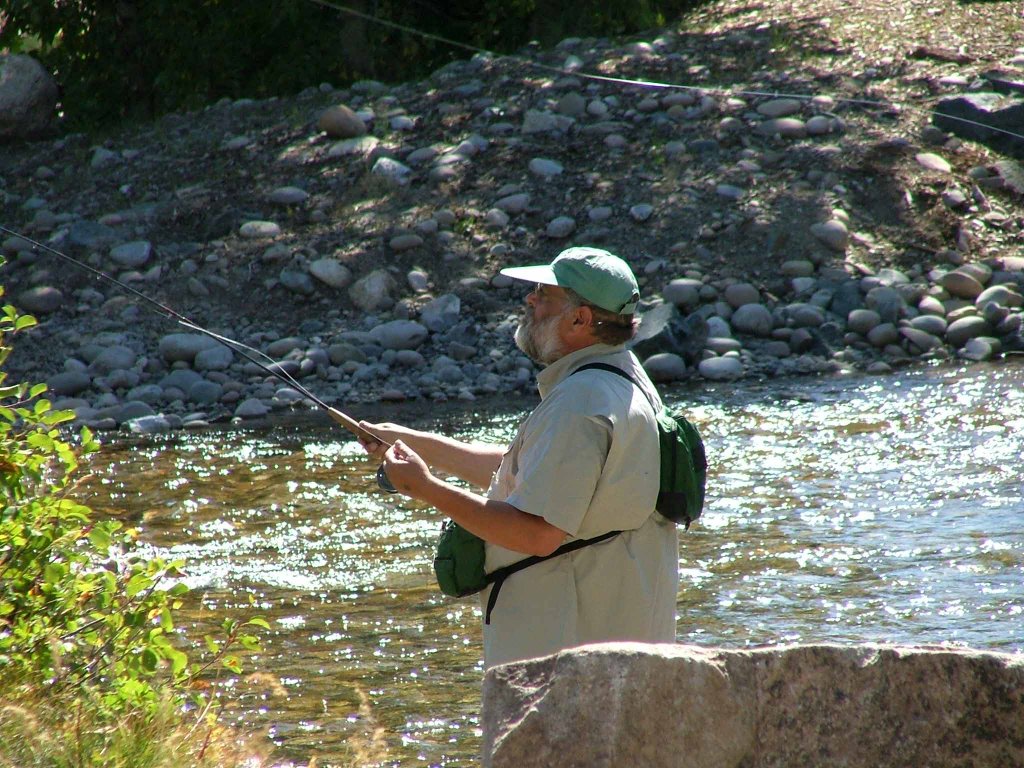
As I mentioned a couple weeks ago, fishing and family vacations are not easy to mix together, but we decided that Friday was the day I was going to fish. Accordingly, on Wednesday I visted the Snake River Angler in Moose Wyoming (just outside the south entrance to Grand Teton National Park) and started asking for advice.

Since anglers are the bread and butter for such businesses, I bought flies as I was asking questions. The man who helped me was quite forthcoming with information, and dissuaded me from my original plan, which was fo fish Leigh Lake (north of Jenny Lake). His advice was to try the area where Cascade Creek goes into Jenny Lake, and then try Cottonwood Creek, the outlet to Jenny Lake.

All the while he was talking, he was adding flies to my pile, and I was able to stop at two dozen -- which was quite enough. My son added a t-shirt to the pile, and attempted to slip in a few other items, mostly with sharp edges. I went for the shirt, but the knives stayed at the store.

I bought a one day license for Friday, and in the morning of August 11, I got up at 6 am and walked to the boat dock for the early-bird ferry across the lake to the Cascade Canyon trailhead. Jenny Lake is a glacially-scoured basin, thus is quite deep (over 250 feet) with a steep dropoff. Where Cascade Creek comes in, it is fairly shallow, though, and I could wade it comfortably. Well, the scenery was great, and the kingfishers were out and about, but I didn't even SEE a fish let alone get one to take second look at my flies, so I took the ferry back about 9:30 am and Susan, Liam, and I piled into the car and drove down to one of the stream accesses to Cottonwood Creek.

A piece of petrified wood in Cottonwood Creek


The stream bed of Cottonwood Creek where I fished consisted of large glacial cobblestones between 4 and 12 inches in diameter (or larger). They were slick and rolled easily (you can see where this is heading...) Susan sat on a rock near the creek while I gingerly waded out to where I could cast to likely spots.

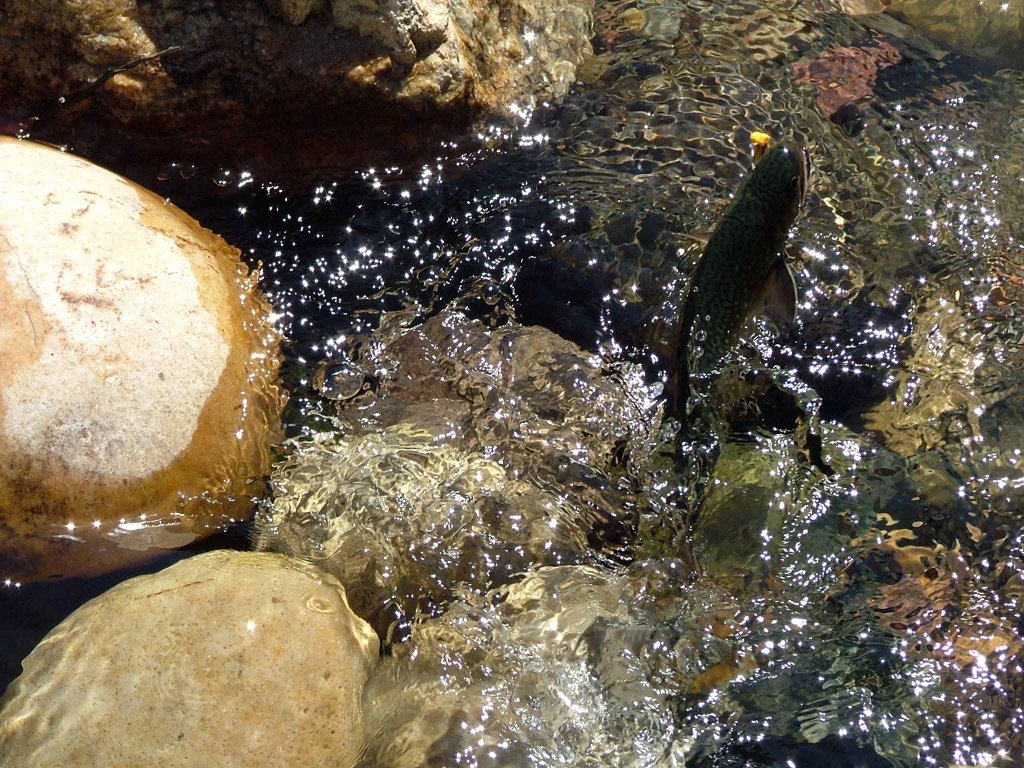
I cast upstream and let the fly drift down. There were a number of belly flashes, indicating that a trout had been interested enough to take a second look, but it seemed they were not interested enough to take the offering. At least they were looking up... I tried letting the fly drift past me and downstream near the concrete supports for the one-lane bridge. This was a bit more productive, as I felt a strike. I turned so I could play the fish more comfortable, and the cobbles rolled beneath my feet. I fell and landed on my side in the creek, but I had the presence of mind to make sure I didn't fall on my rod. Susan, who had been taking lots of pictures, somehow failed to record my undignified posture for posterity.

When I got up, I picked up the rod, and to my surprise, the trout was still on. I played it quickly, and as I took it in my hand, it squirmed and took off expeditiously for cover. It was a nice brook trout, about 8 inches.

I kept on fishing at that location, and played 4 more fish (or maybe the same fish 4 times), but these managed to unhook themselves. Or as fly anglers prefer to put it, these were LDRs (long distance releases). In any case, it was nice to be able to fish, and I decided to call it a good day, and we went back to camp and had lunch.

Wyoming (whose laws govern fishing in Grand Teton National Park), is trying to restore native cutthroat trout, and has a special bonus limit on brookies, and I was actually looking forward to helping in that process. My major disappointment though, was that I didn't catch any cutthroats. My fishing preferences tend toward small streams and native trout, and these are often at odds with the management practices. There are cutthroat trout, brook trout, rainbow trout, brown trout, and lake trout to be had in the various waters of Grand Teton and Yellowstone National Parks. Of all these trout, only the cutthroat are native, and when the Lewis and Clark expedition passed near this area 200 years ago, that was what they caught and ate.

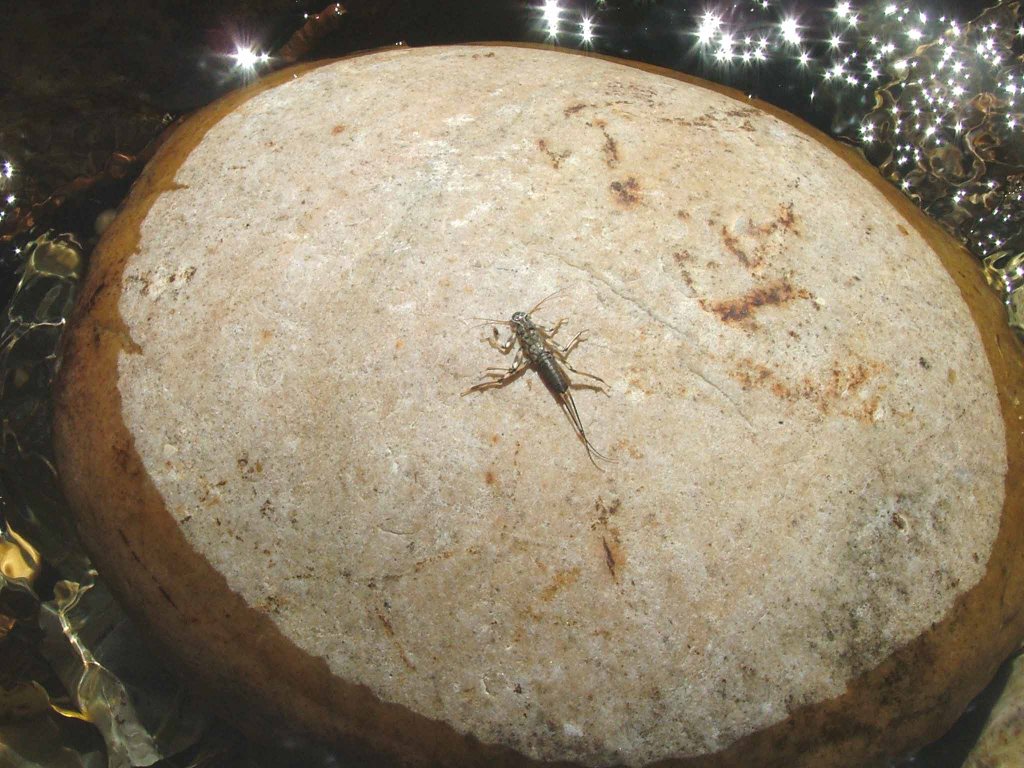
An indicator of what was on the trout's menu

Unfortunately (in my opinion), state fisheries managers had catered to the wishes of anglers to catch large fish and a lot of them, and stocking programs have imported non-native trout to fill this perceived need. It is good to see the state of Wyoming working with the National Park Service to restore the native fish, and I hope they are successful.

It was a great pleasure to fish on Friday, especially in an area of such beauty, and I hope I can fsh more. It is such a relaxing way to spend time.

All photos in this posting were taken by my wife, Susan Melia-Hancock

Sunday, August 13, 2006

In Kearney, Nebraska

We are 2/3 of the way home, and I am taking advantage of the fact that Super 8 has free wireless. After doing the final download of images from my camera to my laptop, I fired up Firefox and checked in with the blogs.

We did about 800 miles yesterday and have about 400 to go, and it should be smooth sailing.

Suffice it to say that the trip was great, and the weather likewise.

Here is a sample of what we saw:


This is the full moon setting over Grand Teton taken at dawn on August 10, 2006.

More will follow over the next few days.

Thursday, August 03, 2006

Off to Teton/Yellowstone

We'll load the Escape tomorrow, and we've resolved to leave when that task is accomplished, rather than set some arbitrary departure time. Of course we never seem to move on schedule, anyway....

The route I plotted takes us past not one, but two Cabelas stores, both in Nebraska. Funny how that turned out. We'll stop and do a little sightseeing, and I plan to purchase some additional outdoors clothing, and I expect Susan and Liam will do the same.

We will start back on August 12, which also happens to the be one year anniversary of the first post on this blog. It has been an interesting year, and one that has been a lot of fun. On my return, I plan to catch up on the news, and start posting again.

In the meantime, I'll be thinking of all of you and, no doubt, wishing that I could attach to a network somewhere. (yes, I will have my laptop. I will be dumping digital images on a daily basis)

Tuesday, August 01, 2006

Airborne Chaplains Corp Oldest in Military

Airborne Chaplains Corp Oldest in Military:
Washington Post (free registration required)
"FORT BRAGG, N.C. -- They look like the other soldiers, but the Army's airborne chaplains are noncombatants who carry camo-clad Bibles instead of weapons when it's time to leap from aircraft onto the battlefield.

Chaplains were authorized for the Army by the Continental Congress in 1775, making the Army Chaplains Corps the oldest in the American military. Today, chaplains are paired with well-armed enlisted soldiers in a Unit Ministry Team, or UMT, as they walk a line between the military and a supreme being. ..."
Here is a good article about the chaplains in the US Army, and how they share the danger that their "flock" endures. I have a great respect for how these men and women have responded to God's call.

Technorati tags: , ,

Monday, July 31, 2006

Envisioning the Presbyterian Church (USA)

Envisioning the Presbyterian Church (USA):
Presbyterian Outlook (free registration required)
Where there is no vision, the people perish, (Proverbs 29:18a KJV)

“On life-support,” opined a minister when asked about the state of the Presbyterian Church (U.S.A.). “In need of hospice care,” said another. These opinions envision the Church on its deathbed awaiting palliative drugs and last rites. I would argue that such a vision is neither faithful to God’s promises nor consistent with the PC(USA)’s present realities.

This article is my alternative to prophecies of the PC(USA)’s imminent death. Following a summary of my perspective, it identifies God-given resources available to the PC(USA). It then focuses on major challenges confronting the PC(USA) and concludes with my personal vision statement.
John Williams, the Synod Executive for the Synod of Mid America writes in the Presbyterian Outlook about the challenges facing the Presbyterian Church (USA) and the hope he has that we can meet those challenges.

What he has to say on cultural disestablishment is interesting. Even though the Constitution prohibited Congress from establishing religion or preventing the free excercise wherof, the Church enjoyed a long period of cultural establishment that seems now to have come to an end. How we choose to live within this reality is going to affect our future as a denomination.

From my perspective, this "cultural disestablishment" is not a bad thing. We are not called to be indistinguishable from the surrounding culture. On the contrary, we are called to follow the Lord and to be a transformed and tranforming example to the world. Can we do that effectively if we are molded by the various worldviews around us?

Williams' scriptural quote that leads off his article summarizes succinctly what we need -- Where there is no vision, the people perish -- and that vision is clearly laid out for us in Scripture.

Technorati tags: ,

Friday, July 28, 2006

Sysadmin Appreciation Day

Beau Weston, over at the Gruntled Center had an interesting posting on Sysadmin Appreciation Day as it relates to some arcane sociological concept. Arcane, at least to me.

A friend send me an email pointing this high holy day to me, and I basked in the thought that there are some people who appreciate the behind-the-scenes things we do to keep the packets flowing.

At 9:03 pm I received a phone call from the data center -- there had been a University-wide power outage and the UPS systems had kicked in as they should have. The only problem was the backup generator did not, and the UPSes drained after a few minutes, and the data center went dark. I met the two other sysadmins for our group, and we managed to get everything going in a little under an hour.

I guess this was an appropriate day to get called in after hours. It really doesn't happen that often, but when it does, it's a doozy.

Thursday, July 27, 2006

Getting Psyched For Vacation

In a little over a week, my wife, son, and I will get into the car and start heading west with the intention of being at the Lizard Creek Campground of Grand Teton National Park in time to select our home for the next 6 nights. Personally, I am hoping for good shade, and a view of the Northern shore of Jackson Lake.

We'll use this location as a base for day trips into the Yellowstone National Park and the surrounding areas. The entry fee is good for both parks, and we may just pick up a Golden Eagle Passport that will pay the entry fees at most US fee areas.

Cameras and walking staffs will be an important part of our week, and I have perrmission to take some time for fly fishing. Mixing fishing and family vacation is a dicey proposition, and some anglers of my acquaintance just don't do it. Fly fishing is pretty much a solitary activity, and family vacations are, well, a family activity...

The Wyoming non-resident angling fees are, to my Missourian sensibilties, pretty outrageous at $11/day, but fishing in Yellowstone requires only a Yellowstone permit at $20/week. Of course, I am looking at one or two days of fishing, tops, so I may try out the Grand Tetons one day and Yellowstone another day.

I took stock of my flyboxes and I am pretty well fixed for flies, although I plan to tie up a few more before I go.

Missouri flies tend to be pretty sparse with the materials:
This fly has no name, but is tied with javelina bristles and grizzly hackle.

Western flies tend to be large and fuzzy:
Stimulator

Here is my version of large and fuzzy:

Adams Wulff

And if the caddis flies are out and about, here is a pretty simple, yet effective fly:

CDC Caddis

CDC stands for cul de canard and refers to the feathers around a duck's preen gland. These are naturally water-resistant, thus these flies float nicely.

Tuesday, July 25, 2006

Should I stay or should I go?

Should I stay or should I go?:
Presbyterian Outlook (free registration required)
by Fairlight Collins-Jones
07/24/06

"It had been one week since the gavel was laid down at the General Assembly in Birmingham, Ala. My energy level had rebounded—it can be tough work as an “observer.” But, I was finding it more difficult to bounce back emotionally and vocationally from GA. After hours of debates in committee, debates on the floor, asking whether or not the minority should become the majority report, trying to figure out LES (the electronic report system) and hearing countless people refer to the decline of the Presbyterian Church (U.S.A.) and threats of leaving, I was left wondering isn’t there more to life than this? Is there a place to start over fresh? Is staying in this denomination worth it? ..."
Collins-Jones has written a thoughful piece on why she is planning to stay with the PC(USA). As a self-identified "catholic, evangelical, Reformed, feminist, missional, genX, liturgical, charismatic, female person", she often feels out of place, but she is willing and eager to be a part of a church that has its problems, but also has a clear mission in the world.

There has much talk of schism, with the attendant finger-pointing. Frankly, I do not understand why so many people who identifiy themselves with renewal are so ready to act in a way that is counter to renewal.

Beau Weston feels that the movement will fizzle out, based on history. I sincerely hope he is correct.

From my perspective, I see a debate going on, egged on by people within and without the PC(USA), that potentally has the same damaging effects as the perennial debates on sexuality. There is so much more that unites us than divides us, and our failure to work with our inherent unity is a blight on not only the PC(USA), but the Church as a whole. Surely we can do better.

The Reverend Collins-Jones closes with this:
"...I am staying because the Spirit of the Lord still rests on the PC(USA). I am not taking my ball and going to another game. Frankly, I am not leaving until I get kicked out! Perhaps there will come a day when I will have to refuse to bow down to any idol that the PC(USA) has begun to worship and in turn, I get the boot. But I have hope that the church will create a new presence in the world, that a revival and renewal is headed our way. Lord, don’t let us miss it! But, thanks be to God that ultimately our hope is not in a denomination, but in the Head of the Church, Jesus Christ."
Amen!

Technorati tags: ,

Sunday, July 23, 2006

God, Under a Microscope

God, Under a Microscope:
Washington Post (free registration required)

by Richard Ostling, AP
"... Francis S. Collins led the international Human Genome Project that mapped the 3.1 billion chemical base pairs in humanity's DNA. He now directs the U.S. government program on applying that information to medical treatments.

He has also emerged as an advocate for faith and its compatibility with science.

The 56-year-old Collins discussed the clash of science and religion last weekend during a conference at Williams College sponsored by the C.S. Lewis Foundation. The writings of the English literature scholar were instrumental in Collins's conversion. ..."
It is good to see scientists who are willing to go beyond the traditional realm of the scientific method, and realize that there is more than one way to understand reality. I was especially interested to note that it was his reading of C.S. Lewis' Mere Christianity that led to Francis Collins' conversion from atheism to Christianity.

Like Richard Dawkins, Collins is at or near the top of his field, having earned the respect of the scientific community. Unlike Dawkins, Collins did not see religion and science as being mutually exclusive, nor did Collins approach religion with the antipathy that Dawkins seems to have.

Collins does not enjoy complete acceptance for his views, as he believes the evidence for evolution to be overwhelming. His view on both creationism and intelligent design is that they undermine the credibility of faith. Creationism is fundamentally flawed, as it is based wholly on untestable assertions, and intelligent design makes assumptions about gaps in our knowledge that can be studied, and filled in by science.

This reminds me of a statement in my freshman biology textbook from Fall 1970 -- to allow one's faith to stand or fall on any aspect of the physical universe that can be observed or tested, risks having science destroy that faith.

Collins' new book The Language Of God: A Scientist Presents Evidence For Belief, was published on July 11, 2006, and is available from Amazon.com.

Technorati tags: , ,

Friday, July 21, 2006

Constitutional Lawyer: Churches CAN Speak to Moral Issues in the Public Square

Constitutional Lawyer: Churches CAN Speak to Moral Issues in the Public Square:
"RAPID CITY - With plenty of misinformation and misunderstanding going around this election season, the South Dakota Family Policy Council believed it was important for churches and their pastors to know just what they were permitted to do and what they were not permitted to do within the parameters that govern their tax exempt status. To help with this, they invited Gary McCaleb, the Senior Vice President of the Alliance Defense Fund (ADF) to speak to South Dakota pastors. ..."

"...Gary McCaleb intends to reassure churches and pastors that they can and must speak to the relevant moral issues in our society, and that they can do so without any fear of jeopardizing their status with the IRS. ..."
As long as that is ALL the churches do, there should be no problem, but too many congregations on the right and the left side of the political spectrum seem to abuse the system. And neither the right nor the left seems to think it is THEIR problem; it's always the other side.

Years evenly divisible by 2 are always a problem when it comes to the truth, and when the year is also evenly divisible by 4, the amount of truth-telling drops to quadrennial lows.

I keep hoping the rhetoric will improve, but thus far have been disappointed every election cycle.

Technorati tags: ,

Thursday, July 20, 2006

Why I will stay Presbyterian

Why I will stay Presbyterian:
(Presbyterian Outlook, free registration required)
by Marj Carpenter
07/20/2006

"Many of you have heard me preach that I am “sinfully proud of being a Presbyterian.” After each General Assembly I ask myself “Are you still?” And the answer is always yes—even after attending 27 straight.

I never agree with all the decisions made, but I still come away Presbyterian. I’ve always been proud of our historic heritage in forming the United States. I know the break-aways always try to claim this “as well” but they can’t quite pull it off.

And all of you who have heard me know there is one thing I consider the most important of all – mission, mission, mission.

In our history we have been the Protestant denomination that opened the most mission fields. And we’re still doing it. We don’t always have the most missionaries out there but we go in first when it’s really tough. I only wish we could concentrate on that—taking the gospel into all the world, to all nations, including our own.

Many churches we have started around the world have a difficult time understanding some of the decisions we come up with at our Assemblies. That’s all right. I have a difficult time understanding them as well. But I am still Presbyterian and nobody will run me out of my church, which I firmly believe is still taking the message of Jesus Christ into the world. ..."
As usual, Marj Carpenter speaks her mind -- and she has earned the right to express her opinions.

She is one of two recent moderators who have distinguished themselves by their clear and effective support of Mission (the other is the immediate past moderator, Rick Ufford-Chase). While the two do not always agree on other issues, they are united in their advocacy for getting out in the world and following Christ. And I think both would agree that our effectiveness is adversely affected by all the things that divert us from mission.

Thank-you, Marj, for calling us back to our duties.

Technorati tags: , ,

Tuesday, July 18, 2006

On the day after adjournment

On the day after adjournment:
Presbyterian Outlook (free registration required)
"...Calvin goes on to argue that the quality of life of one’s fellow church members should not be the basis on which one decides whether to stay or leave the church. Speaking of those who would leave the church in offense over the behavior of others, he points to the Apostle Paul’s remarks in I Corinthians 5 and 11. He comments that “in thinking it a sacrilege to partake of the Lord’s bread with the wicked, they are much more rigid than Paul. For when Paul urges us to a holy and pure partaking of it, he does not require that one examine another, or everyone in the whole church, but that each individual examine himself.” (IV, I, 15). The theme of sections 17-22 of this chapter of Book IV is summarized as “The imperfect holiness of the church does not justify schism, but affords the occasion for the exercise within it of forgiveness of sins.” (Book IV, Section I). ..."
Joan Gray, moderator of the 217th General Assembly has posted a reflection on the aftermath of this year's meeting in Birmingham. In this short excerpt from the middle of her article, she calls on John Calvin to offer a suggestion on how to approach al this talk of apostasy and schism.

Reading this triggered some memories of my reading the Book of Confessions several years ago, and I went back to the Second Helvetic Confession, Chapter XVII, and located this:

WE MUST NOT JUDGE RASHLY OR PREMATURELY. Hence we must be very careful not to judge before the time, nor undertake to exclude, reject or cut off those whom the Lord does not want to have excluded or rejected, and those whom we cannot eliminate without loss to the Church. On the other hand, we must be vigilant lest while the pious snore the wicked gain ground and do harm to the Church. -- Book of Confessions 5.140
The section preceding the above quote likens the Church to a net that catches all kinds of fish (Matthew 13:47) or a field in which both wheat and tares are found (Matthew 13:24).

I sincerely hope and pray that the PC(USA) will not split over the PUP report, especially since so much that was good came out of GA 217.

We are not called to ignore problems in the name of "unity", but neither are we called to go through the field uprooting the weeds we see. We are to be vigilant and, as Calvin suggests, examine ourselves first, realizing that imperfection in the Church is not neccesarily grounds for schism.

Nearly 450 years ago there was near schism in the newly reformed Church, and the Second Helvetic Confession was a response to the charges and countercharges of heresy being hurled back and forth in the mid-1500s. The Church survived then, and the Church can survive today.

Technorati tags: , , ,

Monday, July 17, 2006

Mainline denominations losing impact on nation

Mainline denominations losing impact on nation:
By Steve Levin, Pittsburgh Post-Gazette

The foot soldiers in some of America's greatest battles carried neither guns nor swords. Instead, armed with Bibles and faith in God's mercy, they prayed and marched and fought to end slavery, improve social welfare and establish civil rights.

Members of those churches, some of which became known as mainline denominations, were society's vanguard, shaping the country's culture and refining debate.

But those times are long past. Today, the opposite is occurring as secular culture defines mainline churches' dialogue on everything from social issues to politics and morality, tellingly shown this summer at the emotional and acrimonious national gatherings of the Presbyterian Church USA and the Episcopal Church.
Steve Levin has written a somewhat lengthy analysis of how the so-called mainline denominations have gone from being leaders in social change to allowing social pressures to define how they believe.

Ironically, the denominations that led the move toward the abolition of slavery and addressing other social justice issues did so out of a strong sense of where God was leading them. They could be described in today's terms as "evangelicals", although I suspect they would have considered themselves nothing more or less than followers of Christ.

Technorati tags: , , ,

Sunday, July 16, 2006

Experiencing Life at the Margins - Christianity Today Magazine

Experiencing Life at the Margins - Christianity Today Magazine:
As a longtime friend and partner of North American Christians, what have you noticed about us?

One of the gravest threats to the North American church is the deception of power—the deception of being at the center. Those at the center tend to think, "The future belongs to us. We are the shapers of tomorrow. The process of gospel transmission, the process of mission—all of it is on our terms, because we are powerful, because we are established. We have a track record of success, after all."

Yet recently the Lord led me to an amazing passage, the encounter between Jesus and Nathaniel in John 1. Nathaniel has decided Jesus is a non-entity. Jesus comes from Nazareth, after all.

Nathaniel's skepticism comes from being in power, being at the center. Those at the center decide that anyone not with us is—not against us—[but] just irrelevant. "Can anything good come from Nazareth?" It doesn't warrant our time. But the Messiah is from Nazareth.

Surprise, Nathaniel!
This interview with the Rt. Rev. Dr. David Zac Niringiye, assistant bishop of Kampala in the Church of Uganda is an eye-opener, and a string reminder that Western Christianity is not necessarily where the Church is thriving.

In the early 1970s I recal hearing about missionaries from Third World countries coming to the United States to serve us. My reaction then was one of astonishment followed by condescension -- like seeing a child try to take on the mannerisms of an adult.

By the late 1980s and 1990s, I had grown sufficiently to be highly embarrassed when an Anglican prelate from one of the developed countries responded to an action of the 1998 Lambeth Conference (led mainly by Third World bishops) by saying that these were children in the faith, and that when their faith matured they would be more in line with their European and American counterparts. The particular issue, by-the-way, is still threatening schism in the worldwide Anglican Communion.

One particularly interesting part of this interview is the Rt. Rev. Dr. David Zac Niringiye's shifting of emphasis from the "Great Commission" (go into the world...) to the "Great Invitation" (come, follow me...).

Christianity is growing at its margins, and that may explain a lot about why the Church seems to stagnate where it has been established for a long time. It also is caution that what are now the margins may eventually become the stagnant center. Here is where the "Great Invitation" needs to be heard again and responded to -- and we can be thankful to our fellow Christians at the margins for calling us to follow Christ.

Technorati tags: , ,

Saturday, July 15, 2006

PC(USA) - News Service - Altogether in one place

PC(USA) - News Service - Altogether in one place:
"GULFPORT, MS — “It was visual Christianity in action,” said a team member describing her experience at Orange Grove Volunteer Village here. “It’s awesome how God has brought us together — Presbyterians from east and west to respond to real need.”

Orange Grove is one of six innovative volunteer villages launched by Presbyterian Disaster Assistance (PDA) in response to devastation left by category 5 Hurricane Katrina, along with Wilma and Rita, which followed close on her tail. ..."
Here is a timely reminder from Presbyterian News Service that even though we are in the midst of the 2006 hurricane season, that the work is not done with respect to the devastation of 2005.

Congregations, mission committees, and presbyteries need to keep thinking about disaster relief, even when no immediate disasters are looming, and keep sending work teams and dollars to assist in the Katrina/Rita cleanup efforts.

Technorati tags: ,

Thursday, July 13, 2006

Blogging the Bible - Proof that God loves bald men! By David Plotz

Blogging the Bible - Proof that God loves bald men! By David Plotz:
"Some skeptical readers doubted that my Bible reading would last past Exodus. Oh, it's all thrills and giggles when you're dealing with the Ten Plagues and the Tower of Babel—but wait till you get to Leviticus! They mentioned "Leviticus" in the same hushed, terrified way that mariners mutter "Bermuda Triangle," or Hollywood executives whisper "Ishtar." Leviticus, I was warned, makes even learned rabbis weep with boredom, turns promising young Talmudic scholars into babbling US Weekly subscribers. What would it do to an amateur like me? ..."
Follow the link above, and find out why it can be inferred from Leviticus that God appreciated baldness...

David Plotz who is, in his own words, "a proud Jew, but never a terribly observant one.", picked up a Torah during a particularly boring bat mitzvah, and started reading the story of Dinah and her brothers. This convinced him that he was woefully ignorant of the foundation of his own faith, and resolved to do something about it. This series is the result. Plotz's May 16th post describes in greater detail what it was he set out to do, and why.

His style is witty, and he seems to have much less of an axe to grind than many Christian biblical scholars. Ordinarily I would not take any spiritual direction from someone who does not proceed from belief, but David Plotz has taken an interesting approach. He deliberately avoids commentaries, preferring to read it with fresh eyes and going with the plain meaning of the words he is reading (in many cases, for the first time). Like many who read the Bible, he is perplexed by many passages, amused by others, and suprised by what he has found.

I look forward to seeing his future postings.

Technorati tags: , ,

Wednesday, July 12, 2006

Advisory Opinion on PUP released

Quotidian Grace has a posting concerning the release Saturday of an advisory opinion from the State Clerk of our denomination

The opinion confirms that the outcome is subject to review, but goes on to ask that we give deference to the deliberations of ordaining bodies. What it ultimately boils down to is whether PJCs have the moral courage to do their jobs.

Does it clarify things? No. It leaves things pretty much where they have been. We have a long history of paying lip service to connectionalism, but only when we get our way.

Can we live with it? Why not? We have been living with it for many years. Sessions and presbyteries that have found connectionalism inconvenient will continue to ignore the constitution, regardless of the outcome of the PUP report. Permanent Judicial Commissions that have been disinclined to uphold the Book of Order will continue to be so. But the Church goes on -- and there are many PC(USA) congregations and presbyteries that provide a welcome for those with orthodox beliefs.

On a personal note, I have already made it clear that my threshhold for "peaceably withdrawing" is nowhere near being reached, and if that even became an issue for me there is one thing that would make it very difficult -- I cannot be a part of a denomination that tells women that their gifts for teaching, preaching, and leadership are not wanted. And, sad to say, in the Presbyterian tradition outside the PC(USA), women's gifts are denied with few exceptions. The Evangelical Presbyterian Church has local option, but the one in my community chooses not to excercise the option. We have no Cumberland Presbyterian Church where I live. So my choice is to stay.

Technorati tags: ,

Tuesday, July 11, 2006

The Lure of Theocracy - Christianity Today Magazine

The Lure of Theocracy - Christianity Today Magazine:
As we flee decadence, we must watch where we step.
by Philip Yancey

"I recently attended a gathering called Sounds of Hope, which brought together Christian leaders from predominantly Muslim countries such as Egypt, Lebanon, and Jordan. Listening to their reports of life as a beleaguered minority in a turbulent region got me thinking about the interface between Christianity and Islam.

Several years ago a Muslim man said to me, "I find no guidance in the Qur'an on how Muslims should live as a minority in a society and no guidance in the New Testament on how Christians should live as a majority." He put his finger on a central difference between the two faiths. One, born at Pentecost, tends to thrive cross-culturally and even counterculturally, often coexisting with oppressive governments. The other, geographically anchored in Mecca, was founded simultaneously as a religion and a state. ..."
Here is a thoughtful piece on some of the historical differences in how Christianity and Islam developed, and why their approach to loving society seems so different.

This is a strong caution to those Christians who long for a society where the law enforces a single standard on all, and where dissent is not tolerated.

Technorati tags: , ,

Monday, July 10, 2006

Stunning unity … ambivalence

Stunning unity … ambivalence:

The Presbyterian Outlook (free registration required)
Three votes. Three stunning votes. A fourth stunning vote, too.

After months of relentlessly intensifying drumbeats pounding the threat of an impending split about to befall the PC(USA), 91% of this GA’s commissioners voted to stay together.

After two years of pitched conflict over the Presbyterian Church’s relationship with and advocacy toward Israel and Palestine, this GA proposed a new approach, and 94% of the commissioners voted their support.

After 30 years of wresting over ordination standards, after vote upon vote being adopted by narrow, sometimes paper-thin margins, the 217th General Assembly rejected an attempt to eliminate the fidelity-chastity ordination requirement with 81% support.

Those nearly unanimous vote counts were stunning.

One other vote, the most anticipated vote of the Assembly, stunned the Assembly by its close margin.
Jack Haberer, editor of The Presbyterian Outlook, has weighed in with some comments regarding the Peace, Unity and Purity Task Force report. As a member of the Task Force, he felt it necessary to avoid commenting in it in the Outlook while it was before the General Assembly, but such constraints are no longer in force.

His comments today are, as usual, worth reading.

Technorati tags: , ,

Sunday, July 09, 2006

Cyber-Savvy Pastors Blog When the Spirit Moves Them

Cyber-Savvy Pastors Blog When the Spirit Moves Them:

"Pastor Ben Arment spends several hours each week carefully preparing his Sunday sermon for the 100 members of History Church in Oak Hill. In contrast, he takes just minutes to jot down a few thoughts on faith for his blog; within 24 hours, his message has reached about 300 people. ..."
This is not the first out there, but the Washington Post has taken note of what is proving to be a significant and effective tool in getting the word out.

I suspect that with our recent experience with General Assembly blogging, as well as the many pastors and members who have some kind of presence in the blogosphere, that we are on the exponential leg of the curve. I sure hope the blog servers can keep up with the demand...

Technorati tags: ,

Saturday, July 08, 2006

I'm Baaaack!

I returned home about 12:30pm today, and slept for four hours. Didn't check the blog. Didn't check email. Was out of cell tower range for nearly the entire 10 days. I didn't even listen to my mp3 player. Talk about a technology-free vacation...

Monday my son sat on my glasses, and I had to have my spare pair sent with a leader who was coming out the next day. What is the Boy Scout Motto? Be Prepared? At least I had a spare pair at home...

Today my son shut the car door while my thumb was in the door frame. My right thumb is a lovely shade of purple, but seems otherwise OK. It'll feel better once it stops hurting.

Liam felt awful. His words were "I did it again" (spoken in an anguished tone), but neither occurence was his fault. It was my carelessness, but at least it's nice that he was concerned.

I will be teaching Sunday School tomorrow and I brought my materials with me to camp, and actually had some time to deal with it. The topic is "Elvish Theology", based on The Silmarillion, Morgoth's Ring (Volume 10 of the 12 volume History of Middle Earth, edited by Christopher Tolkien) and two other books written by other authors. The History of Middle Earth is for hard-core Tolkien fans (or fanatics). It's a bit of a change of pace, but I hope it will be fun.

Well, it's off to dinner, and maybe a trip to Barnes and Noble.