Wednesday, November 22, 2006

Penn State -- Twin Star Explosions Fascinate Astronomers

Penn State -- Twin Star Explosions Fascinate Astronomers:
"21 November 2006—Scientists using NASA's Swift satellite stumbled upon a rare sight: two supernovas side by side in one galaxy. Large galaxies typically play host to three supernovas per century. Galaxy NGC 1316 has had two supernovas in less than five months, and a total of four supernova in 26 years, as far back as the records go. This makes NGC 1316 one of the most prodigious known producer of supernovas. ..."

This is pretty impressive, especially when you consider the scale that must be involved here. According to Wikipedia, NGC 1316 is about 100 million light years from Earth. According to HubbleSite, NGC 1316 is 60,000 light years wide. By comparison, our own galaxy, the Milky Way is estimated to be about 100,000 light years in diameter, but its diameter includes the arms that spiral out from a central disc that is much smaller and more compact.

In this image, the large bright blob at the center is the galactic core, and the bright object on the left is a star that is considerably closer than the galaxy itself. The two supernovae are circled, and the one on the right was first noted on June 19, 2006. The one on the left was first seen on November 5, 2006. They would have gone supernova 100,000,000 years ago -- about the middle of the Cretaceous period.

I can't back this up with facts and figures, but for a long time it has seemed to me that the scientific discipline in which the highest percentage of committed Christians are found is the field of astrophysics. Could it be the sheer awesomeness of what is to be seen here?

The very idea of seeing things that happened so long ago is mind-boggling. Not that many years ago Comet Hale-Bopp passed close to Earth and provided a spectacular view. It's period is approximately 4300 years, placing its last perihelion around 2300 B.C. Who saw it then? What did they think about it?

Ps 8:3 When I consider your heavens,
the work of your fingers,
the moon and the stars,
which you have set in place,
Ps 8:4 what is man that you are mindful of him,
the son of man that you care for him?

-- Psalm 8:3-4, NIV

Tuesday, November 21, 2006

Brazos Bend State Park

Brazos Bend State Park is a 5000 acre park about 30 miles south of Houston. This area is represents the first Anglo settlement in Texas, but archaeologists believe that people first visited the area around 300 B.C. This particular area was part of the land grant from the Mexican government to Stephen F. Austin in the early 1800s. This was an important area in commerce, as the Brazos River is navigable, and served to supply the settlements along its course.

This park is home to a population of American Alligators, and we were hoping to see some, but considering the physical limitations of two of us, we were only able to enjoy a nature walk that looped around Creekfield Lake. There was plenty to see and enjoy, and also to listen to. There were Great Blue Herons, Snowy Egrets, American Coots, Common Gallinules, Common Crows, various sparrows, and I heard what sure sounded like a Pileated Woodpecker.


American Coots were pretty common in Creekfield Lake.


This striking bird is a Common Gallinule, a member of the coot, gallinule and rail family. Note the red beak with its yellow tip. (You'll need to click the image to open it in its normal size.) This is a new addition to my life list.


This little caterpillar was fairly common on the emergent vegetation of Creekfield Lake.


This was the only aquatic reptile we saw, but then we were not able to get to the prime alligator viewing areas.


If there was anything that characterized this visit to Brazos Bend, it would be the vultures. I estimate about there were about 50 Black and Turkey Vultures. They tended to roost in separate trees, but if you look carefully, the uppermost bird on the right in this group of Black Vulture is actually a Turkey Vulture.


Every so often a group of vultures would take flight and circle around. The Black Vultures have the light parts of their wings at the tip, while the Turkey Vultures have the light area extending from the tip along the trailing edge of the wing.

Brazos Bend State Park offers camping, hiking, cycling, birdwatching, fishing, and camping. (Important point of alligator etiquette: If you catch a fish and an alligator wants it, let it have it.)

Monday, November 20, 2006

Thanksgiving in Houston

We are in Houston this week visiting my parents for Thanksgiving.

On our way down we stopped at the Texas Renaissance Festival, as we did last year, and visited my brother Jim. We found to our surprise and pleasure that my niece (sister's daughter) and her boyfriend were participating this year.

Pictures and more will follow soon .... And here they are:

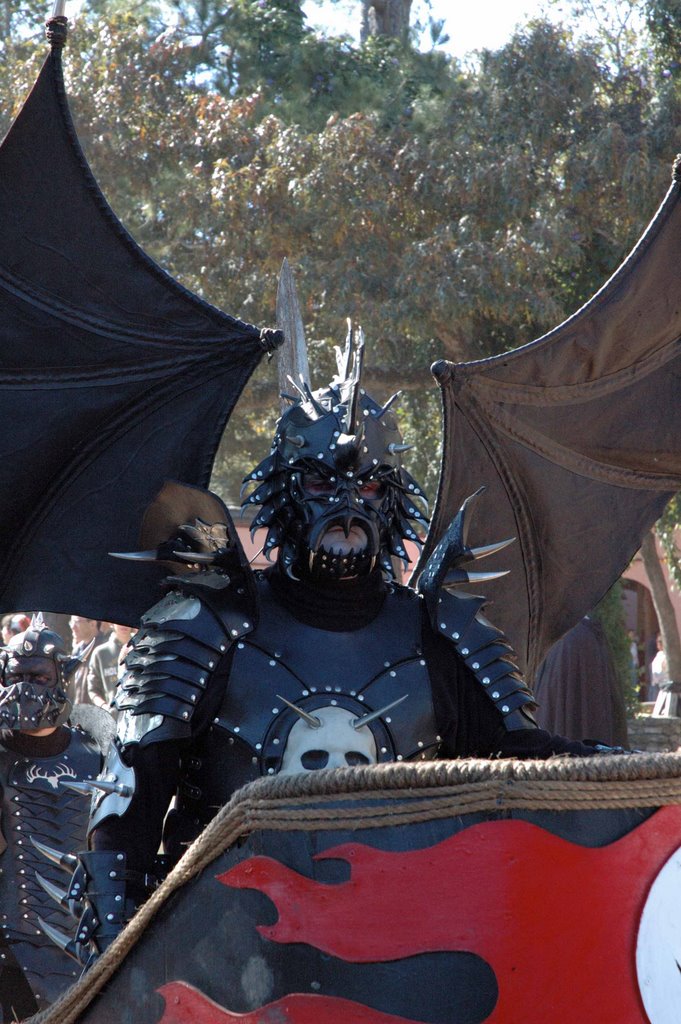
A costumed participant in the noontime parade


I'm not sure just how period-correct this costume is, but he certainly put a lot of effort into it.

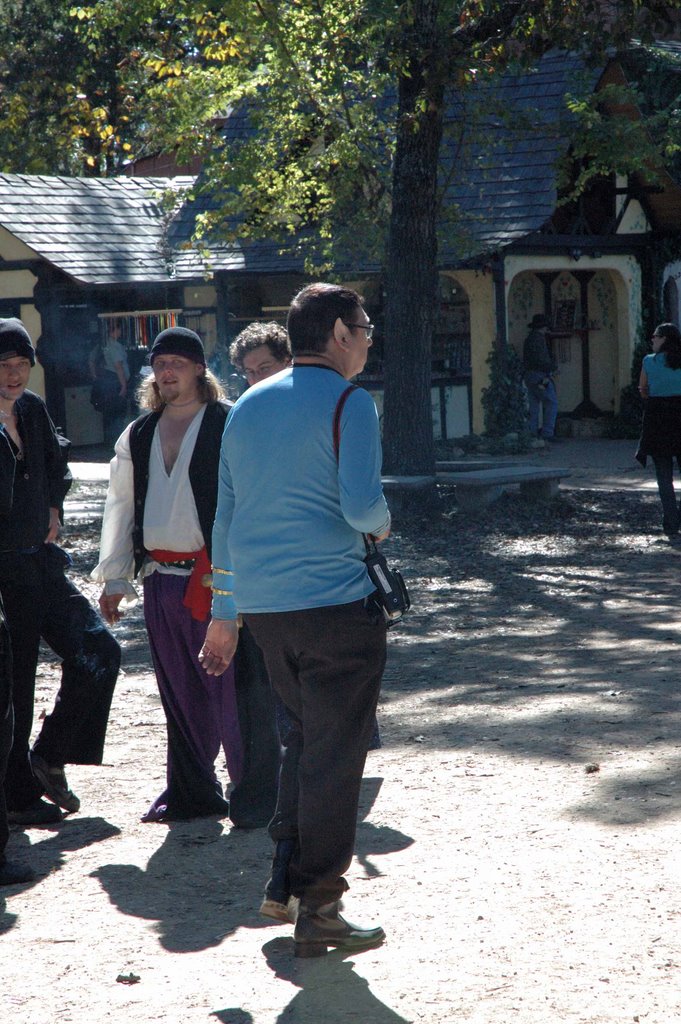
Hmmmm. Must be one of those space-time anomalies....

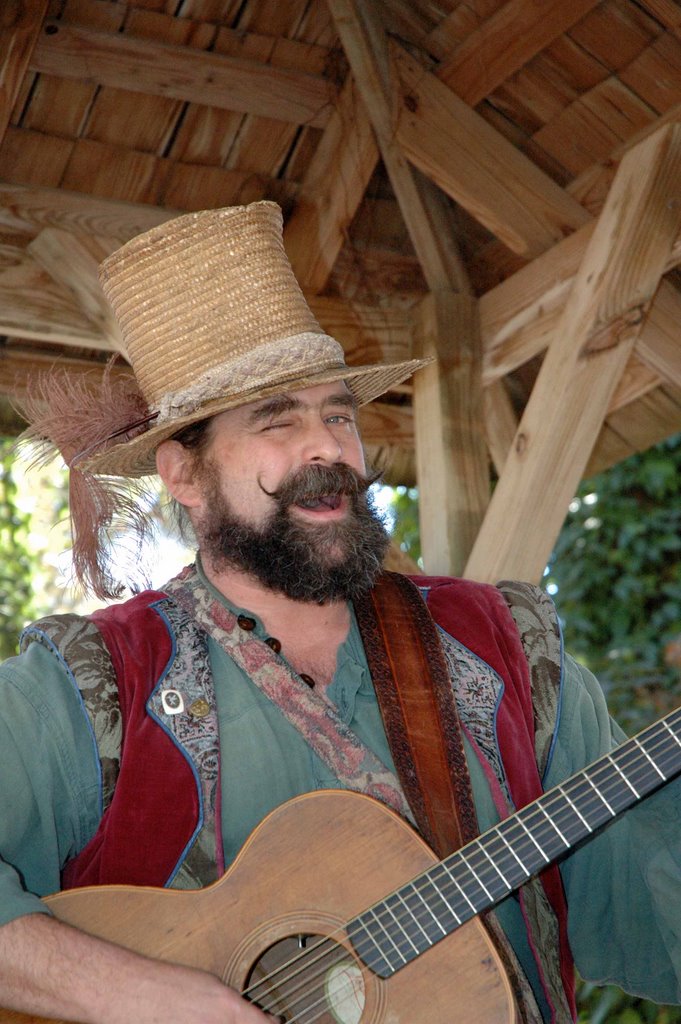
My brother, Jim (AKA The Burley Minstrel)

I decided to leave out the images from the chain-mail fashion show. This is, after all, a blog that I'd like the kids to be able to read.

Presbyterian News Service -- Southern California pastor tapped to lead PC(USA) mission programs

Presbyterian News Service -- Southern California pastor tapped to lead PC(USA) mission programs:
"LOUISVILLE — The Rev. Tom Taylor, a Southern California pastor touted by colleagues as bridge-builder in the Presbyterian Church (U.S.A.), has been named Deputy Executive Director for Mission by General Assembly Council (GAC) Executive Director Linda Valentine.

If Taylor’s appointment is confirmed by the GAC’s executive committee when it meets Dec. 7, he will begin work here Jan. 8.

Taylor, currently pastor of the 1,400-member Glenkirk Presbyterian church in Glendora, CA, will oversee all of the GAC’s mission activities, including supervision of six program directors who will be named in coming days to manage the council’s six restructured program areas. ..."

It sounds like the reorganization of the General Assembly Council staff is well on its way. I hope that our mission in the world will be enhanced by these moves.

Friday, November 17, 2006

PC(USA) - News Service - Philanthropy Expert Says Conservatives Are More Generous

PC(USA) - News Service - Philanthropy Expert Says Conservatives Are More Generous:
"SYRACUSE, NY — Syracuse University professor Arthur C. Brooks is about to become the darling of the religious right in America — and it’s making him nervous.

The child of academics, raised in a liberal household and educated in the liberal arts, Brooks has written a book that concludes religious conservatives donate far more money than secular liberals to all sorts of charitable activities, irrespective of income. ..."

There have been indications of this trend in the PC(USA). In many ways it is not surprising, since those who are orthodox in their theology can be expected to put their faith into practice. For the orthodox, giving to the needy has never ceased to be the responsibility of the Church. We live, however, in a country where the Church has outsourced charitable giving and social programs to the government -- or perhaps more accurately, allowed the government to take over what had been their historical calling. Many, including some within our own denomination, are uncomfortable with the Church involving themselves too heavily in social programs, especially the "faith-based initiatives." Yet the need continues to mount and the governmental programs at all levels are not able to keep up with it, thus the continuing need for the Church to be involved.

Brooks, a professor of public administration at Syracuse University, has written a book being published later this month, called Who Really Cares: The Surprising Truth About Compassionate Conservatism . Amazon.com lists it for release on November 27, 2006, and it is available for pre-order.

Thursday, November 16, 2006

Medical News Today: Dark Chocolate Lowers Blood Clot Risk

Medical News Today: Dark Chocolate Lowers Blood Clot Risk
If you eat a little bit of dark chocolate each day you could be reducing your chances of developing a blood clot, say researchers from Johns Hopkins University, USA. They say dark chocolate helps thin the blood, in pretty much the same way as aspirin does.

I knew it! Dark chocolate is therapeutic. I wonder if my physician will write me out a prescription?

Tuesday, November 14, 2006

Time Magazine: God vs. Science

Time Magazine: God vs. Science
"There are two great debates under the broad heading of Science vs. God. The more familiar over the past few years is the narrower of the two: Can Darwinian evolution withstand the criticisms of Christians who believe that it contradicts the creation account in the Book of Genesis? ..."

"But in fact creationism and I.D. are intimately related to a larger unresolved question, in which the aggressor's role is reversed: Can religion stand up to the progress of science? This debate long predates Darwin, but the antireligion position is being promoted with increasing insistence by scientists angered by intelligent design and excited, perhaps intoxicated, by their disciplines' increasing ability to map, quantify and change the nature of human experience. ..."

Time Magazine hosted a 90 minute debate between Richard Dawkins and Francis Collins in their New York City offices, and that debate comprises the bulk of this quite lengthy article. This was a fairly spirited debate with neither Collins nor Dawkins yielding to the other, yet there are humorous parts as well. There is no question that the two scientists are extremely articulate and present their cases clearly. The Time interviewer was fair, and asked good, probing questions, and there was a minimum of posturing by either side. I suspect the lack of a crowd to which to play had a beneficial effect on this exchange.

All-in-all, I felt that the debate does much to clarify the issues at stake here, and I recommend reading the entire article.

San Diego Presbytery: Task Force on the Way Forward

San Diego Presbytery: Task Force on the Way Forward
"It is the conclusion of the Task Force on the Way Forward that the Presbytery of San Diego is divided and therefore polarized over some key theological issues. As a result we are unable to experience ecclesiastical unity. The advisory survey taken by commissioners at the Special Meeting of Presbytery on October 24, 2006 and the complexion of our recent presbytery meetings confirms our conclusion. As a result of this polarization, our ability to do mission and ministry together is greatly hampered. Often we spend more time arguing our respective positions than proclaiming the good news of Jesus Christ. Much like Paul and Barnabas in Acts 15:36-41, we seem to have reached an insurmountable impasse.

It is time to tell ourselves the truth and bring an end to this entrenched dispute. In our opinion, it is futile to keep arguing our respective cases, hoping to persuade our brothers and sisters in Christ to change their deeply held beliefs and values, while vehemently defending our own. We simply cannot continue in this state of sharp disagreement. We will either continue to fight among ourselves or we will move forward, but we cannot do both. We must find a way to break this destructive cycle and come to a place where mission and ministry take precedence over unproductive debate. We may need to find a way to commend one another to the grace of God so that we can pursue faithful and fruitful ministry options. We must find a common ground where we can work together to further God’s kingdom here on earth, or we must part company. Anything less will not bring glory to God or increase His kingdom here on earth.

Therefore, the Task Force on the Way Forward presents the following recommendations to the Presbytery of San Diego for immediate adoption and implementation. ..."

I have to say that when I first read this I had a deep feeling of disappointment -- but then I started to think about it. San Diego is one of the more conservative presbyteries, and, if memory serves, one of the first to clearly outline what it thought were the Essential Tenets and Reformed Distinctives of our our faith. Even though I am in accord with the general goals and many of the specific stands taken, I recognize that this presbytery (as well as nearly every other in the PC(USA)) is deeply divided on many issues. In far too many of these cases, denomination-wide, the majority prevails and fails to recognize the minority's deep feelings.

San Diego seems to be taking a path that few have chosen and that is to recognize the divisions and a way forward that allows all sides to function more as a church and less as bickering children. This report makes specific recommendation as to how to accomplish this, and it may be difficult to implement, but at least they are trying to avoid the trap of fighting to win every argument by majority vote, but doing nothing to heal the divisions.

Included in this report is the questionaire that was answered by 70 respondents. The answers show clearly the depth of division.

The Paul and Barnabas analogy is one that resonates with me. By finding a way to move forward separately, the work God calls us to perform can be done more effectively. The alternative is to remain paralyzed by our inability to agree. Our disputes seem petty compared with the needs around us, and as much as I abhor the idea of separation, it may lead to greater things for the Presbyterian Church. We need to all remember that the subject of Paul's and Barnabas' disagreement was Timothy. Paul was wrong to dismiss Timothy on the basis of a single failing, but see how the early Church was strengthened -- and see how Paul's and Timothy's relationship developed several years later to the point where they were mutually supportive colleagues in ministry. If our denomination is truly presented with a "Paul and Barnabas" moment, let's not be too stubborn to recognize it.

Monday, November 13, 2006

Presbyterian Outlook: From confusion to clarity

Presbyterian Outlook: From confusion to clarity:
Presbyterian Outlook requires registration to read the full articles, but it is free.
by Jack Haberer

"...As a former member of the Theological Task Force on Peace, Unity, and Purity of the Church (TTF), I have been distressed to see so many Presbyterian friends troubled, perplexed, and even angered by the actions taken by the 217th Birmingham General Assembly in response to the Task Force’s recommendations. ..."

Not much has truly changed with the passing of the PUP recommendations. Judicatories that previously chose to ignore constitutional provisions in making ordination decisions will continue to ignore the Book of Order when it finds its provisions inconvenient. Judicatories that carried out their responsibilities with integrity are free to continue to do so, and many have made it crystal clear that they intend to do so.

What has changed is that a practice has been brought back of permitting "scruples" to be declared and allowing the judicatory to determine whether such scruples place the candidate outside the "essential tenets" of the reformed faith. The Task Force failed to clarify what the essentials are, and we go on as before without any clear understanding of what they are, and without such clarification the job of promoting Peace, Purity, and Unity is going to be very difficult.

I am still willing to give it a fair chance, since the recommendations appeared to strengthen the judicial review of such decisions -- but not enough time has elapsed to see the effect of such reviews.

People seem to be divided in four groups when it comes to the Task Force on Peace, Purity, and Unity recommendations:
  • Those who are in accord with the PUP recommendations.
  • Those who are willing to give them a chance, but have some reservations.
  • Those who are opposed to the recommendations based on a study of the issues.
  • Those who never really intended to consider fairly the recommendations and are using it as a wedge issue to further their own agendas.
The preceding four categories do not account for all Presbyterians, and my gut feeling is that they do not even comprise a majority. We need to recognize that there are those who simply do not understand what is going on because it never really has been clearly or honestly explained by either the supporters or the detractors of the PUP report.

Jack Haberer has much personally invested in the PUP report and recommendations, and I respect his opinions, but the fact that there are so many people out there who are confused suggests very strongly that the Task Force needed to do a much better job of interpretation of their report to the membership.
"...Then again, we Presbyterians are pretty insistent that the sovereign God reigns. And given that God is not the author of confusion (I Cor. 14:33), the people of God listening for the voice of God ought to be able to find their way through a season of confusion into greater clarity. This edition of The Presbyterian Outlook is dedicated to helping us all to listen better, to discern more clearly, and to follow our Lord more faithfully."

This injunction should be heeded by all sides, not only in this dispute, but in all disputes that prevent us from heeding our individual and corporate calling to follow Jesus Christ.

God is not the author of confusion; we are.

Saturday, November 11, 2006

Christianity Today: The Church's Great Malfunctions

Christianity Today: The Church's Great Malfunctions:
"There is a remarkable image in the closing pages of Scripture that has become a touchstone for the way my colleagues and I think about faith and culture. Amid its descriptions of the New Jerusalem, Revelation includes "the tree of life, bearing 12 crops of fruit, yielding its fruit every month. And the leaves of the tree are for the healing of the nations" (Rev. 22:2). The tree holds out hope that whole cultures will be healed and mended, becoming places where people can flourish. And it sets an agenda for faith as a way of life that contributes to that flourishing, in anticipation, here and now.

Too often, however, Christian faith neither mends the world nor helps human beings thrive. To the contrary, it seems to shatter things into pieces, to choke what's new and beautiful before it has chance to take root, to trample underfoot what's good and true. ..."

This was posted yesterday on the Christianity Today website and raises some extremely uncomfortable points. What are these malfunctions? Miroslav Volf separates them into two groups -- the idleness of faith and the oppressiveness of faith.

An idle faith can easily yield to (1) temptation's lure, (2) institutional power, and (3) a misunderstood faith. With regard to the third, Volf refers to Karl Marx, who famously said that "religion is the opiate of the masses." And while that can be true to a point, Volf points out that Marx failed to see that religion can also be a stimulant that energizes people to perform service. Volf also points out that when religion is employed only as a soothing drug or a performance-enhancing drug, it is little more than a crutch. It can, and should be much more than a drug.

With regard to the oppressiveness of faith, Volf points to the violence so often done in the name of religion. He suggests three factors here as well:
  1. A thin faith -- one that puts into practice some of the tenets of faith but not others; i.e. being pro-life, but willing to commit violence to achieve that end)
  2. An irrelevant faith -- Can a 2000-year-old faith actually mean anything in the world today? There is a failure of the intellect here in that people don't try to apply the teachings of Scripture to modern circumstances. This is not a job for theologians; it a the job of all Christians.
  3. An unwillingness to walk the narrow path. Here we can compare the bloody conflicts that revolve around revenge and payback and, say, the response of the Amish community in Pennsylvania that reached out to the family of a man who had killed their children.
I'm sure these aren't exhaustive reasons, but they provide a good place to start a little introspection. Volf says this: "We Christians should be our own most rigorous critics—and be that precisely out of a deep sense of the beauty and goodness of our faith."

Friday, November 10, 2006

Washington Post: Let's Stop Stereotyping Evangelicals

Washington Post: Let's Stop Stereotyping Evangelicals:
" ...Evangelicals led the grass-roots campaigns for religious liberty, the abolition of slavery and women's suffrage. Even the Moral Majority in its most belligerent form amounted to nothing more terrifying than churchgoers flocking peacefully to the polls on Election Day. The only people who want a biblical theocracy in America are completely outside the evangelical mainstream, their influence negligible. ..."
Here's a pretty good article about the stereotypes that have grown up around evangelicals over the years. This article acknowledges that much of it is fueled by the behavior of a small number of self-described evangelicals who say outrageous things, which are then reported widely.

A story that is not told very effectively by the press is that of inner city "megachurches" which are truly multicultural in their makeup and are heavily engaged in social ministries. Nor is the story widely told of evangelical mission workers who place themselves in danger in such places as the Sudan and Somalia as a response to God's call.

The past election involved what seems to be an unusual number of evangelical Democrats winning contests, and these are not the "evangelical left" we are talking about here; they tend toward the conservative end of the religious and political spectrum.
"...Yet it is dishonest to disparage the massive civic and democratic contribution of evangelicals by invoking the excesses of a tiny few. As we recall from the Gospels, even Jesus had a few disciples who, after encountering some critics, wanted to call down fire from heaven to dispose of them. Jesus disabused them of that impulse. The overwhelming majority of evangelicals have dispensed with it as well. Maybe it's time more of their critics did the same."

May it be so.

Thursday, November 09, 2006

CNET: Rights group names 'Enemies of the Internet'

CNET: Rights group names 'Enemies of the Internet':
"Civil liberties group Reporters Without Borders has released its annual list of "Enemies of the Internet"--regimes the group claims restrict freedom of expression online. ..."

This list includes many of the usual suspects, and some surprises. For example, Libya, an obvious suspect and a member of this list for several years, was taken off this year since no apparent censorship is currently taking place and and "cyberdissidents" are not being jailed. Muammar Gaddafi is still viewed with some suspicion, and will, no doubt, be watched closely.

Other issues of concern are the relationships between hardware manufacturers and information providers. Cisco routers, which are a key element in the world's internet infrastructure, is also the provider of the firewall that walls off China from the rest of the world. Yahoo! and Google both have made accommodations to China, and Yahoo! in particular provided email records to authorities that resulted in a ten year prison sentence for a Chinese journalist.

Reporters Without Borders deals with press freedom issues worldwide, and includes bloggers in their concern. They recently had a 24 hour vote on the "Black Holes of the Web" which shows in stark graphics where the major problems are:


Clicking the image will take you to the original site, which will probably be around for a few days.

Sunday, November 05, 2006

Washington Post: In a Tech-Savvy World, the Word of God Goes Mobile

Washington Post: In a Tech-Savvy World, the Word of God Goes Mobile
"The latest cellphone technology brings new meaning to the notion of hearing God's call.

Media-savvy ministries are adapting their message for a new generation of phones, which have memories capable of holding entire books and playing videos and music.

The result: missionaries in Asia beaming testimonials onto a two-inch screen; a three-day, 100,000-person crusade boiled down to a two-minute video sermon; a Christian punk ring tone. ..."

This article goes on to point out that the cell phone has become an ubiquitous part of people's day to day lives -- they go everywhere with their owners. Other issues of etiquette are raised -- for example, is reading your Bible on your cellphone during church acceptable?

The overall conclusions of this article are that this could be a powerful tool in evangelism and spiritual development. I guess I have my reservations. I have carried a cell phone for over ten years, but I still prefer face-to -face conversations, and text messaging never quite has caught on with me. And watching videos on my Motorola Razr, even with its larger screen, just doesn't quite fire my rocket.

Saturday, November 04, 2006

Kitsapsun.com: Disbelief requires a faith all its own

Kitsapsun.com: Disbelief requires a faith all its own:

By DAVID YOUNT
October 31, 2006

"The first book I was assigned to read as a college freshman half a century ago was "Unpopular Essays" by the English earl, Bertrand Russell. His book bore that title because Lord Russell was the most devoted and articulate atheist of his time, with a self-imposed mission to persuade readers that there was no God.

Our philosophy professor, himself a Christian, assigned the book to challenge the comfortable complacencies of a classroom full of Christians and Jews not yet out of our teens. In one of his essays, "An Outline of Intellectual Rubbish," Russell related the story of an American prophetess who, in 1820, gathered thousands of her disciples by a lake in northern New York State. ..."

David Yount, author of Celebrating the Rest of Your Life: A Baby Boomer's Guide to Spirituality, lays out a good case for atheism being a faith-based system of belief. Yount makes an interesting point in his article -- science and faith are both best pursued with a humble attitude, and both are strengthened when faith is tempered with doubt.

Yahoo News: Religion on the Brain

Yahoo News: Religion on the Brain
The California Science Center's Science Matters speakers program "Religion on the Brain" will feature a neurologist presenting the latest findings in brain research about the neural processing of religious thought and experience. In light of this research, panelists will discuss how humans reconcile these different aspects of their brains in understanding the world. The panelists will discuss the possibility that humans are genetically hard-wired for critical thinking and religious spirituality. Can we believe in science and still have faith?

For those in LA, this might be an interesting way to spend a Saturday afternoon. It will be held November 4 at the California Science Center from 1:30-3:30 PM. The panelists consist of two neuroscientists, one evolutionary biologist, and one person who is identified as a "Director of the Skeptics Society". The latter two have written books on the subject.

I look forward to reading about this panel discussion after it has taken place.

Thursday, November 02, 2006

The Eagle and Child: What to do about upcoming elections

The Eagle and Child: What to do about upcoming elections:
"As a pastor, I'm generally pretty chary about sharing my political views. As near as I can recall, I've only written once about a specific public policy issue (a permit for a casino downtown) and never about candidates. This is mainly because I get two uneasy vibes from the general public (not from everyone, but this is a general sense): 1) they view pastors talking about specific political details with the same level of trust as they might view a used car salesman on the merits that '76 Volare that you just have to drive home today. 2) When pastors spend more time talking political policy than talking about Christ, they become pawns of political strategists rather than physicians of souls. (you may disagree with me on these two general senses -- but then I humbly ask, what is your inner response when you hear a pastor espousing political views with which you disagree. Do you immediately dismiss those views, or do you internally begin to challenge your own stances.) ..."

I attended a Presbytery meeting yesterday. During worship, one of the meditations was supposed to be about Grace, but seemed nothing more than a political commercial. There was a stunned silence during this meditation, in contrast to the other two, during which there was active participation from the assembled commissioners in the form of nodding in agreement, occasional laughter, and even an "Amen!".

Russell Smith's posting today reminds us all that God is not the property of any political party, and that we should be praying for wisdom rather than the victory of any party.

Partisanship is a corrosive evil in this country, and it is bad enough that we have to endure it during years evenly divisible by two -- but we are the Church of Jesus Christ, not a political organization. We should be setting the standard, not following the crowd.

Tuesday, October 31, 2006

Reformation 2006

From the Cyber Hymnal:
A Mighty Fortress is our God

A mighty fortress is our God, a bulwark never failing;
Our helper He, amid the flood of mortal ills prevailing:
For still our ancient foe doth seek to work us woe;
His craft and power are great, and, armed with cruel hate,
On earth is not his equal.

Did we in our own strength confide, our striving would be losing;
Were not the right Man on our side, the Man of God’s own choosing:
Dost ask who that may be? Christ Jesus, it is He;
Lord Sabaoth, His Name, from age to age the same,
And He must win the battle.

And though this world, with devils filled, should threaten to undo us,
We will not fear, for God hath willed His truth to triumph through us:
The Prince of Darkness grim, we tremble not for him;
His rage we can endure, for lo, his doom is sure,
One little word shall fell him.

That word above all earthly powers, no thanks to them, abideth;
The Spirit and the gifts are ours through Him Who with us sideth:
Let goods and kindred go, this mortal life also;
The body they may kill: God’s truth abideth still,
His kingdom is forever.

The Cyber Hymnal also includes the original German words, for those who are interested:
Ein’ Fest Burg Ist Unser Gott

Ein’ feste Burg ist unser Gott,
Ein gute Wehr und Waffen;
Er hilft uns frei aus aller Not,
Die uns jetzt hat betroffen.
Der alt’ böse Feind,
Mit Ernst er’s jetzt meint,
Gross’ Macht und viel List
Sein’ grausam’ Ruestung ist,
Auf Erd’ ist nicht seingleichen.

Mit unsrer Macht is nichts getan,
Wir sind gar bald verloren;
Es steit’t für uns der rechte Mann,
Den Gott hat selbst erkoren.
Fragst du, wer der ist?
Er heisst Jesu Christ,
Der Herr Zebaoth,
Und ist kein andrer Gott,
Das Feld muss er behalten.

Und wenn die Welt voll Teufel wär’
Und wollt’ uns gar verschlingen,
So fürchten wir uns nicht so sehr,
Es soll uns doch gelingen.
Der Fürst dieser Welt,
Wie sau’r er sich stellt,
Tut er uns doch nicht,
Das macht, er ist gericht’t,
Ein Wörtlein kann ihn fällen.

Das Wort sie sollen lassen stahn
Und kein’n Dank dazu haben;
Er ist bei uns wohl auf dem Plan
Mit seinem Geist und Gaben.
Nehmen sie den Leib,
Gut, Ehr’, Kind und Weib:
Lass fahren dahin,
Sie haben’s kein’n Gewinn,
Das Reich muss uns doch bleiben.
Frederick Hedge's English translation is remarkable close to the original.

Christianity Today: Grappling with God

Christianity Today: Grappling with God

Prayer sometimes feels like a hug and a stranglehold at the same time.

"The church I attend reserves a brief time in which people in the pews can voice aloud their prayers. Over the years, I have heard hundreds of these prayers, and with very few exceptions, the word polite applies. One, however, stands out in my memory because of its raw emotion.

In a clear but wavering voice, a young woman began with the words, "God, I hated you after the rape! How could you let this happen to me?" The congregation abruptly fell silent. No more rustling of papers or shifting in seats. "And I hated the people in this church who tried to comfort me. I didn't want comfort. I wanted revenge. I wanted to hurt back. I thank you, God, that you didn't give up on me, and neither did some of these people. You kept after me, and I come back to you now and ask that you heal the scars in my soul."

Of all the prayers I have heard in church, this one most resembles the style of testy prayers I find replete in the Bible, especially those from God's favorites such as Abraham and Moses. ..."

I can relate to Yancey's story here. I have felt the embarrassed silence when similar prayers have been offered in small groups. I, too, have been embarrassed. It's almost like I'm ready to apologize to God for the impertinence of my fellow Christians.

But is it impertinence? Or is it more honest than many prayers offered in public or private settings?

This article is well worth reading.

Sunday, October 29, 2006

Faith and Values in Politics

There has been a lot of "buzz" in politics about how the Democrats are trying to appeal to the Christian voters by talking more freely about their faith and about their values.

Daniel Pulliam over at GetReligion posted an article this morning called Religious Democrats on the March, in which he starts off with a response to a recent Newsweek article with the cover teaser "Not Your Daddy's Democrats. " He points out that the Democrats are returning to their historical roots. It may not be his daddy's Democrats, but it seems to look more and more like his granddaddy's Democrats.

In today's Indianapolis Star, Russ Pulliam, Associate Editor, had this to say regarding the Democratic Disconnect on Faith and Values:
The story of William Jennings Bryan, founding father of the modern Democratic Party, offers a clue as to why Democrats are having a hard time connecting with faith and values voters.

It also raises the question of whether Democrats can recover Bryan's Christian faith and find a Bryan-like figure among their presidential prospects. One interesting possibility: Illinois Sen. Barack Obama, who is thinking about running.

A century ago Bryan lost three presidential races, but he paved the way for future successful liberal Democratic Party presidents, Woodrow Wilson and Franklin Roosevelt, and their bigger federal government initiatives. Losing at the ballot box, Bryan won the battle of ideas, according to a new biography, "A Godly Hero," by Michael Kazin. He did it by appealing to biblical truths.

William Jennings Bryan was a Presbyterian elder and found himself on the losing side not only in politics, but in the controversies of the 1920s over which direction the Presbyterian Church would take. He tended toward progressive beliefs in the political realm, but was quite conservative in his religious beliefs. He lost narrowly when he ran for moderator of General Assembly on a creationist platform. He died in 1925, not long after his involvement in the Scopes Trial in Dayton, Tennessee.

As I was composing this I noticed that both authors to whom I referred were named "Pulliam". I was leaning toward it being a coincidence, but when I checked Daniel Pulliam's profile on GetReligion, I noticed that he did an internship at the Indianapolis Star. It still may be a coincidence...

Saturday, October 28, 2006

Streamlining the Book of Order

In my personal library I have a Presbyterian Hymnal published in 1843 by the Presbyterian Church in the United States of America (a predecessor denomination of the PC(USA)). In addition to its 236 pages of metrical Psalms and its 679 hymns, there are 82 pages consisting of The Form of Government of the Presbyterian Church, The Directory for Worship, and The Shorter Catechism. The Westminster Confession is not included in this hymnal (which is 3 inches wide, 5 inches tall, and an inch and a half thick).

Without belaboring the obvious, the Constitution of the Presbyterian Church, which today consists of Part One (The Book of Confessions) and Part Two (The Book of Order), has evolved from a succinct constitutional document to a sometimes bewildering smörgåsbord of confessions, ordinances, and rules to cover everything from proper representation on judicatories to which presbytery gets to examine and ordain a candidate for the ministry. Some have said the constitution has become a manual for operations. I tend to look at it as a progression from general principles to specific instances. However one looks at it, it has bloated to the point where its usefulness is diminished as elders and ministers try to determine what part of "shall" is essential or, dare I say it, what the meaning of "is" is.

In this environment the 217th General Assembly commissioned a task force to study how to streamline the Book of Order with the charge to develop a document that:
  • Preserves the foundational polity of our church;
  • Focuses on providing leadership for congregations as missional communities;
  • Provides sufficient authority and flexibility to presbyteries to assist congregations in addressing cultural, economic, and societal challenges facing the church;
  • Provides flexibility at all levels of the church;
  • Is guided by the first four principles from the Report of the Theological Task Force on the Peace, Unity, and Purity of the Church, and
  • Preserves the wording of G-8.0200 and G-6.0106b in their current form. (For the precise wording of the task force’s charge, please see Item 05-11.)
To this end, the Task Force has issued a draft chapter that address the Form of Government and a draft chapter on the Foundations of Polity. In addition, there is an outline of the remainder of the Form of Government section, which is pretty skeletal at this time.

I have read over these documents, but have not done any in-depth analysis. I really am not a polity wonk (unlike Moderator Joan Gray, who wrote the book). My initial impressions are that it is definitely simpler that what it proposes to replace, yet there are themes and phrasing that hearken back to the 1843 Form of Government.

Whether this endeavor will succeed in streamlining our polity without sacrificing what it means to be Presbyterian and Reformed remains to be seen, but I look forward seeing how this takes shape in the coming year or so.